The Human Moat
Last revised 9/29/2026

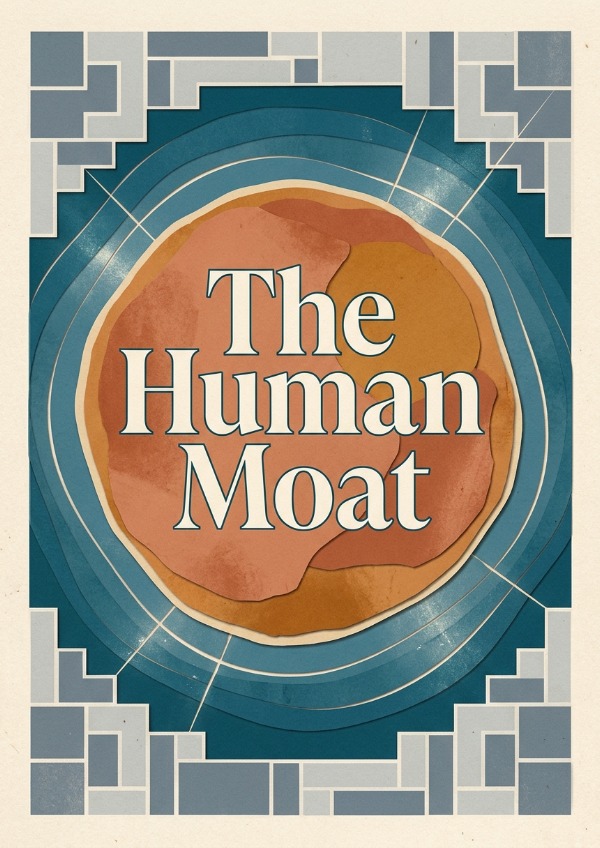
The Human Moat

AI keeps getting stronger — here is what to build that it structurally cannot replicate, and how to compound it

Version: 1.0

A strategic framework for building durable personal value in the age of AI. This collection starts from a counterintuitive premise: the stronger AI gets, the more valuable certain human capacities become — not less. Not because those capacities are immune to automation, but because they operate in domains where AI's architecture gives it fundamental disadvantages: embodied experience, long-horizon identity, taste under ambiguity, relational trust, and the willingness to bear real consequences for a decision. The collection maps those domains, names the five moat types, and gives readers a practice for deepening them — using AI as an accelerator, not avoiding it.

ManifestoPlaybook
Earn4.34CreditsinArtificial IntelligencePersonal Development
8Modules40Sessions368Cards82Quizzes

Modules in this Collection’s System

The Moat Thesis

Why the strongest response to AI is not competition but differentiation.

4Sessions

What AI Structurally Cannot Do

Not what it currently fails at — what its architecture makes permanently hard.

5Sessions

The Five Moat Domains

A framework for where to invest your development effort.

5Sessions

Building Your Moat

Moats are not discovered — they are built through deliberate, sustained investment.

6Sessions

The AI Amplification Paradox

The best moat strategy is not to avoid AI — it is to use it so well that your human advantages compound faster.

5Sessions

Career Strategy in the AI Era

Practical positioning for the next decade.

5Sessions

The Inner Game

The psychological dimension of building a moat in an age of machines.

5Sessions

The Long View

What this means for the next ten to twenty years — and what it means for right now.

5Sessions

What You'll Walk Away With

  • 5moat domains for building durable personal value against AI displacement
  • 1moat audit framework for assessing which of your current skills are appreciating vs. depreciating
  • 4career positioning strategies for the next decade of AI advancement
  • 3compounding practices for deepening judgment, taste, and relational capital
  • 5psychological disciplines for staying in the arena when AI output looks effortless

You'll Have Answers To

  • ?What are the specific human capacities that AI's architecture makes it structurally unable to replicate?
  • ?How do you tell which of your current skills are appreciating versus depreciating as AI advances?
  • ?Why are competent but undifferentiated professionals the most exposed to AI displacement?
  • ?What does a deliberate moat-building practice look like in a knowledge worker's actual week?
  • ?How does using AI well actually accelerate — not undermine — your human moat?

Critical Concepts Explored

Human MoatMoat AuditThe Five Moat DomainsConsequential RepsThe Dangerous MiddleAI Amplification ParadoxSkill Half-LifeTaste Under AmbiguityThe Leverage EquationCompounding Reputation
Editor's Note
“The career strategy collection that treats AI honestly — as both the pressure and the lever.”

What makes this collection distinctive is its refusal to reassure. It names the five domains where human advantage is structural, gives readers a moat audit to assess their own position, and makes the counterintuitive case that the best moat-builders are also the best AI users. The tone is strategic, not anxious — a framework, not a pep talk.

Editor's Brief
Who it's for
Knowledge workers, professionals, students, and career-builders who feel the pressure of AI advancement and want a strategic framework — not reassurance, not panic — for building durable personal value that compounds as AI gets stronger.
What stands out
This collection does not reassure readers that humans are special. It names the five specific domains where human advantage is structural, gives readers a self-assessment for their own moat, and provides a compounding practice for deepening it — using AI as an accelerator, not avoiding it.
Read if
Read if you suspect that being competent but undifferentiated is a losing strategy in the AI era, and you want a clear-eyed framework for what to build underneath the tools.
Gold Quotes
The strongest response to AI is not to outrun it at its own game but to play a different game entirely.

AI is extraordinary at pattern completion, knowledge retrieval, and generation at scale. It is structurally weak at embodied judgment, identity coherence, relational depth, and consequential commitment. The people who will thrive are the ones who build so deeply in those domains that AI becomes their amplifier, not their replacement.
About the Curator
WWorking with AI

Working with AI is a LearningFirst editorial line publishing field-level skills for working professionals adapting to AI in their daily craft. The aim is durable practice, not feature coverage — the patterns that transfer across tools and outlast any one model release.