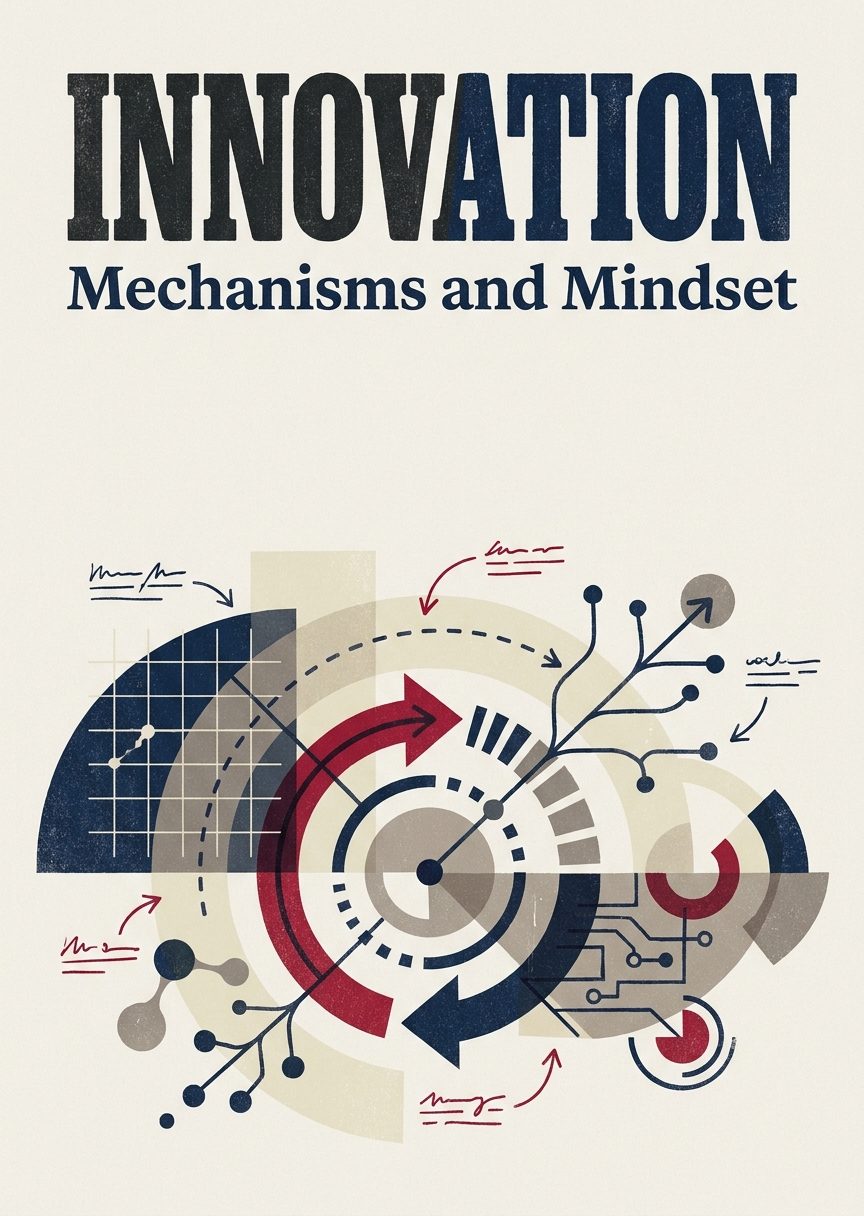
Innovation — Mechanisms and Mindset
Last revised 10/8/2026

Innovation — Mechanisms and Mindset

The conditions that produce innovation and the skills that let you contribute to it

Innovation has an anatomy. It emerges from identifiable conditions — psychological, social, institutional, economic, cultural — and it is exercised through learnable skills of perception, thinking, judgment, and execution. This collection integrates both halves into a single arc: the landscape of innovation drivers and the personal operating system for generating and realizing new ideas. The thesis is that innovation is neither mysterious talent nor simple method — it is a discipline, and both its knowledge and its practice are learnable.

DisciplineField Guide
Earn4CreditsinInnovationCritical Thinking
7Modules33Sessions360Cards97Quizzes

Modules in this Collection’s System

The Innovation Question

What innovation actually is, why most people misunderstand it, and the evidence that it has identifiable drivers.

4Sessions

The Inner Engine

The psychological and motivational conditions inside the person who innovates.

5Sessions

The Social Multiplier

Ideas travel, combine, and improve through human connection — innovation is a social phenomenon.

4Sessions

Pressure and Constraint

The counterintuitive driver: limitation as the mother of innovation.

4Sessions

Structures That Produce Innovation

The economic, legal, institutional, and cultural infrastructure that makes innovation rewarding or futile.

5Sessions

The Innovator's Toolkit

Perception, ideation, evaluation, and execution — the learnable repertoire for seeing and making the new.

6Sessions

Becoming an Innovator

Sustaining innovation as a daily discipline — timing, luck, habits, and identity.

5Sessions

What You'll Walk Away With

  • 7innovation drivers that explain why breakthroughs cluster in specific places and periods
  • 5cognitive conditions inside the person who innovates — from curiosity to the prepared mind
  • 4institutional design principles that make innovation rewarding instead of futile
  • 6thinking tools for perception, ideation, evaluation, and execution
  • 5daily habits that compound into a richly stocked, observant, innovative mind

You'll Have Answers To

  • ?Why does innovation cluster in specific places and periods — and what do Renaissance Florence, postwar Bell Labs, and 2010s Shenzhen have in common?
  • ?What is the difference between invention and innovation, and why does the gap between them matter more than either one alone?
  • ?Why do constraints and scarcity produce more innovation than abundance and unlimited resources?
  • ?What are the specific cognitive skills that separate people who generate valuable ideas from those who do not?
  • ?How do you build a daily practice that compounds into the capacity to innovate — rather than waiting for inspiration?

Critical Concepts Explored

Innovation vs. InventionInnovation ClustersIntrinsic MotivationThe Prepared MindWeak TiesThe Medici EffectPsychological SafetyAdjacent PossibleDivergent ThinkingInnovation Identity
Editor's Note
“The rare collection that treats innovation as a serious intellectual subject rather than a motivational exercise.”

Most innovation content sells inspiration. This collection sells understanding — the actual mechanisms behind innovation clusters, the psychology of creative drive, the institutional designs that produce breakthroughs. It moves from Florence to Shenzhen to your daily habits without ever losing its evidence base.

Editor's Brief
Who it's for
Students and early-career professionals who want to understand what actually produces innovation — and build the personal skills to contribute to it.
What stands out
This collection integrates the structural drivers of innovation (why it clusters in certain places and periods) with the personal operating system (how to see problems, generate ideas, and execute) — two halves that are almost always taught separately.
Read if
Read if you want to stop using the word 'innovation' as a buzzword and start understanding it as a discipline with identifiable mechanisms and learnable skills.
Gold Quotes
Almost every iconic lone-genius story dissolves under scrutiny into a network story — the myth prevents people from creating the conditions that actually produce innovation.

Edison had Menlo Park. Jobs had Wozniak, Ive, and Xerox PARC's interface research. Einstein's 1905 papers drew on a circle of physicists in Bern. The lone-genius narrative makes innovation seem like a gift rather than a product of conditions, and that misunderstanding is the single largest barrier to creating those conditions deliberately.

About the Curator
TThe Innovation Discipline

The Innovation Discipline studies where breakthroughs come from and how they are made — examining the conditions, institutions, and personal skills that produce innovation across every field.