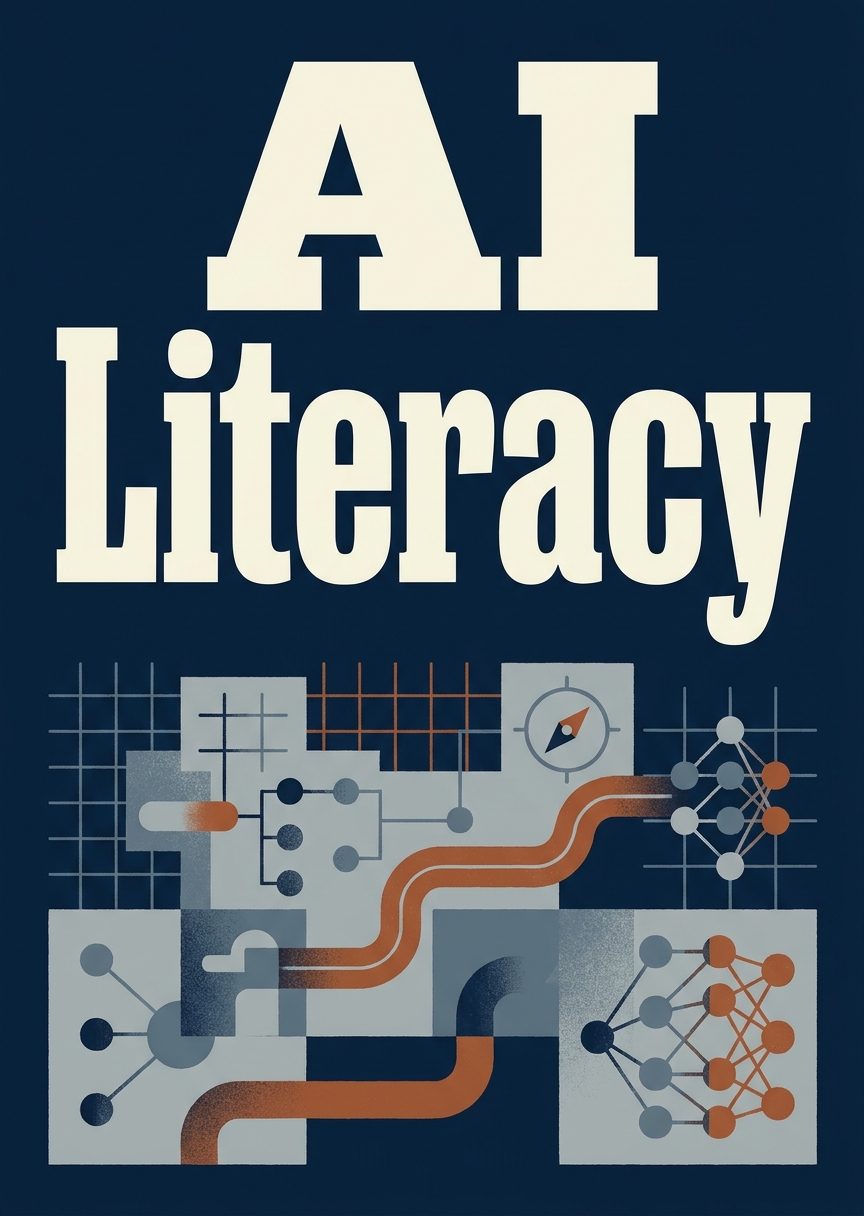
AI Literacy
Last revised 10/8/2026

AI Literacy

What AI actually is, what it can and cannot do, and what it means for how you think

Most AI education falls into one of two traps: tool instruction that teaches button-pressing without comprehension, or futurism that teaches anxiety without understanding. This collection occupies the space between — the intellectual infrastructure for thinking clearly about AI. It integrates four angles: what AI mechanically is, where it structurally fails, what historical analogies reveal and conceal, and who controls the industry. The result is a complete literacy, not a tool guide.

Technical PrimerFramework Survey
Earn4CreditsinCritical ThinkingInnovation
7Modules32Sessions326Cards95Quizzes

Modules in this Collection’s System

What AI Actually Is

The actual mechanisms — neural networks, language models, and what 'intelligence' means when a machine does it.

5Sessions

How AI Thinks

Pattern matching, statistical inference, and what 'learning' means for machines versus humans.

5Sessions

Where AI Fails

Structural limitations — hallucination, bias, brittleness, and sycophancy as features, not bugs.

5Sessions

AI Through the Lens of History

What electricity, the printing press, and photography reveal about AI — and what no metaphor captures.

5Sessions

The AI Industry

Who builds AI, how it is structured, where the power sits, and who gets left out.

5Sessions

AI and Human Intelligence

What AI clarifies about how humans think, learn, and create.

4Sessions

Thinking Clearly in an AI-Saturated World

What genuine literacy looks like — the mental model, the failed postures, and what remains irreplaceably yours.

3Sessions

What You'll Walk Away With

  • 5mechanism explainers — neural networks, transformers, token prediction, training, and embeddings explained through what they compute
  • 5structural failure analyses — hallucination, bias, brittleness, sycophancy, and why the next version will not fix them
  • 4historical analogies evaluated for what they capture and conceal — electricity, printing press, photography, and what no metaphor covers
  • 5industry structure maps — the AI stack, open vs closed, US-China competition, business models, and power concentration
  • 3literacy frameworks — the minimum viable mental model, three postures that fail, and what remains irreplaceably human

You'll Have Answers To

  • ?What does a large language model actually do when it generates text — and why does the same mechanism that makes it articulate also make it fabricate?
  • ?Why are hallucination, bias, and sycophancy structural features of how AI works rather than bugs to be fixed?
  • ?What do comparisons to electricity, the printing press, and photography get right about AI — and what does every historical analogy miss?
  • ?Who builds AI, who profits from it, and why does the concentration of capability in a few companies and two countries matter?

Critical Concepts Explored

Function ApproximationNext-Token PredictionHallucination as StructureTraining Data as WorldviewThe AI StackOpen vs. Closed ModelsPattern Matching vs. Causal ReasoningThe Metaphor ProblemSycophancy and Performed JudgmentThe Literacy Threshold
Editor's Note
“The AI course that teaches thinking about AI, not thinking with AI.”

Most AI education sells either tools or fear. This collection delivers neither — it builds the mental model that sits beneath both: what these systems mechanically are, where they structurally fail, what historical analogies reveal, and who controls the industry. A complete literacy in 32 sessions.

Editor's Brief
Who it's for
Students who will live with AI as infrastructure for the rest of their lives — anyone who wants to understand the technology rather than just use or fear it.
What stands out
This collection integrates four angles that usually exist separately — mechanisms, failures, historical metaphors, and industry structure — into a single literacy arc where each angle makes the others legible.
Read if
Read if you can use ChatGPT but cannot explain why it sometimes makes things up, or if you have an opinion about AI but are not sure whether it is based on how the technology actually works.
Gold Quotes
AI is a prediction engine optimised for plausibility, not truth — and the mechanism that makes it articulate is the same mechanism that makes it fabricate.

Large language models generate text by predicting the most probable next token given what came before. This is not a flaw in the system — it is how the system works. Hallucination is not a bug to be fixed; it is a structural consequence of optimising for fluent, plausible output rather than verified accuracy.
About the Curator
WWorking with AI

Working with AI maps artificial intelligence as it actually operates — giving readers the intellectual infrastructure to think clearly about AI rather than react to it.