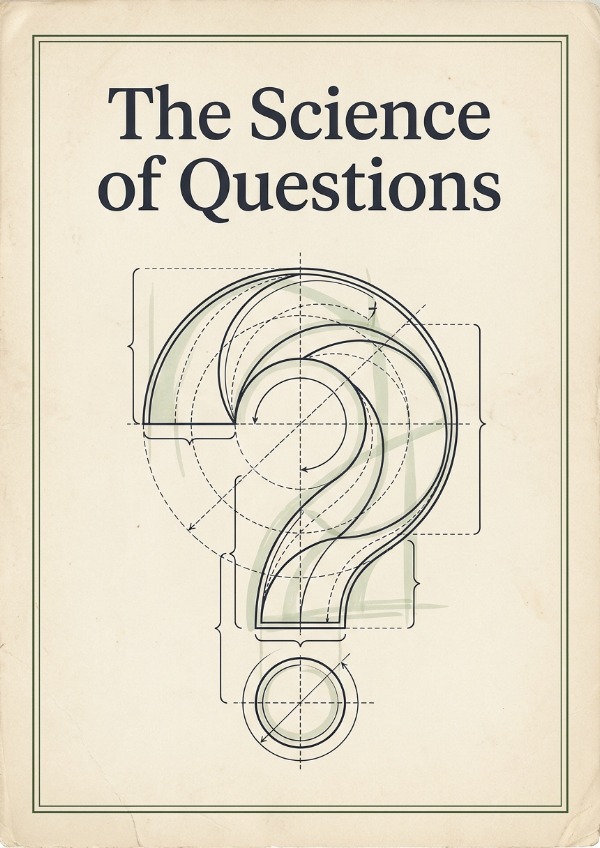
The Science of Questions: The Academic Foundations
Last revised 8/9/2026

The Science of Questions: The Academic Foundations

A scholarly survey of questioning — its philosophical foundations, cognitive science, and practice domains

This collection offers a scholarly survey of questioning — drawing on philosophy, cognitive science, pedagogy, research methodology, dialogue theory, and the applied literatures of law, medicine, journalism, and civic discourse. The treatment is academic: each article engages the primary research, names the debates, and traces the mechanisms. But the audience is any serious reader, not just specialists. The goal is to give a general reader the same foundational understanding of questions that a researcher or practitioner in these fields would carry — the kind of grounding that makes practical improvement not just possible but principled.

Field GuideCurriculum
Earn12CreditsinArtificial IntelligenceCritical ThinkingEpistemology
10Modules75Sessions735Cards150Quizzes

Modules in this Collection’s System

Foundations: The Philosophy, Logic, and Epistemology of Questions

*What a question is, what it does, and what it means to know through asking — before any of it becomes a technique.*

11Sessions

The Cognitive Science of Questioning

*How attention, memory, load, and curiosity shape the questions that work.*

8Sessions

Questions in Teaching and Learning

*The classroom literature translated into practical question design.*

7Sessions

Assessment, Measurement, and Survey Design

*The professional craft of writing questions that measure what they claim to measure.*

9Sessions

Inquiry, Discovery, and the Questions That Create Knowledge

*How disciplined questions govern investigation, strategy, and evidence — and how the right question creates what was not there before.*

8Sessions

Dialogue, Persuasion, and Therapeutic Inquiry

*How questions behave when the medium is another person.*

10Sessions

Failure Modes and Anti-patterns

*The traps that make inquiry biased, performative, or unsafe.*

8Sessions

Questions in the Age of AI

*Why cheap answers make question quality more valuable.*

7Sessions

Civic and Deliberative Inquiry

*How public institutions ask, frame, and contest questions at scale.*

3Sessions

Synthesis: A Theory of Good Questions

*A working practice for designing, choosing, and living with questions.*

4Sessions

What You'll Walk Away With

  • 7question taxonomies from philosophy, linguistics, and cognitive science — the research distinctions, not folk categories
  • 8learning-science findings on how question design shapes memory, understanding, and curiosity
  • 9assessment-design criteria from psychometrics and educational research on what separates a measuring instrument from noise
  • 8failure-mode patterns — the structural features that make questions leading, coercive, performative, or epistemically dishonest
  • 7criteria for evaluating any question — a research-grounded instrument applicable across domains
  • 4applied domains where questioning research has produced the clearest practice implications: coaching, journalism, deliberative democracy, and AI

You'll Have Answers To

  • ?What is a question actually doing — structurally, epistemically, socially — before anyone answers it?
  • ?Why do retrieval practice, wait time, desirable difficulty, and generation make some questions teach better than explanations?
  • ?How do assessment professionals write questions that are valid, fair, and hard for the right reasons?
  • ?What separates questions that create knowledge from questions that merely verify it?
  • ?What changes about questioning when AI makes fluent answers nearly free?

Critical Concepts Explored

Erotetic LogicHermeneutic CircleAbductive ReasoningDesirable DifficultyRetrieval PracticeCognitive LoadItem ValidityProductive QuestionsCalibrated QuestionsQuestion Literacy
Editor's Note
The scholarly foundations of questioning — traced from erotetic logic to the science of inquiry.

This is an academic survey written for general readers: structured around primary sources and live debates rather than conclusions and tips, and more interested in the mechanism of questioning than in shortcuts. Readers who want foundations before practice will find it unusually rigorous for a collection of this length.

Editor's Brief
Who it's for
Curious generalists, educators, researchers, and practitioners who want scholarly foundations — not a how-to guide, but the primary-source understanding that makes any practical improvement principled.
What stands out
It crosses the silos that questioning research actually occupies — philosophy of language, cognitive science, psychometrics, dialogue theory, civic discourse, and AI — at a depth most accessible treatments refuse to go.
Read if
Read if you want to understand questioning at the level of mechanism, and are willing to spend time with the research rather than its summary.
Gold Quotes
A question is never just a request for information; it is a frame that decides what kind of thinking is allowed.

The same sentence can invite retrieval, diagnosis, invention, confession, or defense. Once you see the frame, question design stops being a soft skill and becomes a design problem for thought. Every domain in this collection — teaching, measurement, therapy, negotiation, AI — confirms the same structural finding.

About the Curator
WWorking with AI

Working with AI is a LearningFirst editorial line for durable professional skills in an AI-shaped workplace. This collection extends that line upstream: before tools, prompts, and workflows, there is the craft of asking.

The Science of Questions: The Academic Foundations | LearningFirst