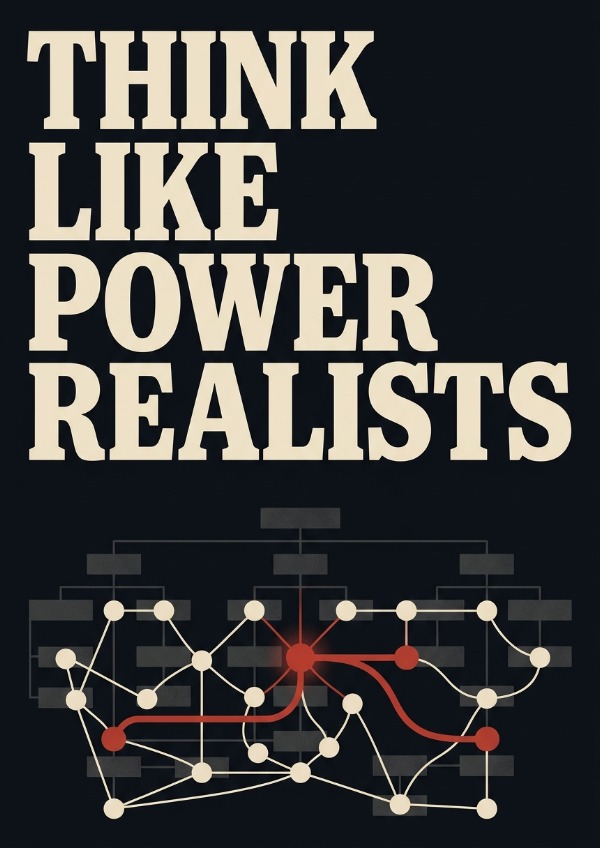
Think Like Power Realists
Last revised 9/30/2026

Think Like Power Realists

How to read the operating system that runs beneath the official story

This collection teaches you to decode how power actually operates — who holds it, how they maintain it, what they tell themselves about it, and what they tell everyone else. Drawing on a tradition that runs from Thucydides through Machiavelli to James Burnham and Robert Caro, it equips you with a vocabulary for reading the gap between stated reasons and actual motives, the structural forces that constrain even the most powerful actors, and the recurring patterns that make power dynamics legible rather than mysterious. Each session delivers one transferable analytical tool — elite theory, the principal-agent problem, agenda-setting, budget analysis, the veto player — that sharpens how you read organizations, institutions, and decisions. You finish able to see through the official story in any setting you operate in.

Mental OSReframe
Earn4CreditsinCritical Thinking
6Modules30Sessions307Cards70Quizzes

Modules in this Collection’s System

The Realist's Lens

The foundational concepts that separate realist analysis from both naive idealism and lazy cynicism.

5Sessions

The Classical Realists

What Machiavelli, Thucydides, and their contemporaries actually argued — stripped of the caricatures — and why their analysis remains operational.

5Sessions

The Modern Realists

Burnham, Caro, Bismarck, Kissinger, and the structural analysts who mapped how modern institutions operate.

5Sessions

Power in Organizations

Corporate politics, boardroom dynamics, principal-agent problems, and the mechanics of how decisions actually get made.

5Sessions

Reading Power in Real Time

A diagnostic method for any setting: how to decode who holds power, whose interests are being served, and how to tell performance from substance.

5Sessions

The Realist's Ethics

Description versus endorsement, institutional design, complicity, and the boundaries of realist thinking.

5Sessions

What You'll Walk Away With

  • 1realist's diagnostic method for reading who holds power in any setting — organization, market, or political system.
  • 5classical and modern frameworks — from Machiavelli's fortuna/virtu to Burnham's managerial revolution — stripped of caricature and made operational.
  • 4organizational power mechanics — principal-agent problems, information control, agenda-setting, and veto players — for reading how decisions actually get made.
  • 1ethical grounding for realist analysis — the distinction between seeing power and worshipping it, and the line between literacy and complicity.

You'll Have Answers To

  • ?Why did Thucydides record Athens telling a small island 'the strong do what they can, and the weak suffer what they must' — and why does the same logic replay in modern boardrooms?
  • ?What did Machiavelli actually argue, and why does stripping away the caricature reveal a thinker more relevant than most contemporary strategists?
  • ?How did Robert Caro spend decades mapping power and discover that the real story of any institution is not its org chart but the informal networks of the people who actually run it?
  • ?If the budget is the real strategy, what does your organization's budget reveal about what it actually believes?
  • ?What separates the realist who sees power clearly and acts with integrity from the one who becomes complicit in what they observe?

Critical Concepts Explored

Power as Unit of AnalysisThe Stated-Actual GapElite TheoryIron Law of OligarchyStructural InterestsThe Managerial RevolutionAgenda-SettingThe Veto PlayerRealpolitikPower Literacy
Editor's Note
“The grammar for reading what power actually does — recovered from the thinkers who mapped it.”

Rather than political theory or cynical hot takes, this collection isolates the analytical methods that Thucydides, Machiavelli, Burnham, and Caro used to decode how power operates — and applies them to the organizations, boardrooms, and institutions readers navigate daily. Its section on organizational power mechanics is unusually practical, and every session delivers a diagnostic tool you can use immediately.

Editor's Brief
Who it's for
Strategists, leaders, managers, founders, and intellectually serious professionals who suspect that the official account of how decisions get made is incomplete and want a structured framework for reading what is actually happening.
What stands out
It recovers the realist tradition from caricature — Machiavelli as a tragic analyst, not a villain; Burnham as a prophet of modern management, not a polemicist — and applies their methods to the organizations and institutions readers navigate every day.
Read if
Read it if you have ever watched a decision get made and sensed that the stated reasons and the actual reasons were not the same thing, and you want the vocabulary to name exactly what you saw.
Gold Quotes
Power is not hidden because powerful people are secretive — it is hidden because most people lack the vocabulary to describe what they are looking at.

Realism is that vocabulary. It does not tell you what the world should look like. It gives you the grammar for reading what the world actually does — the gap between stated reasons and actual motives, the structural forces that constrain even the most powerful actors, and the patterns that make power dynamics legible rather than mysterious.
About the Curator
TThink Like Great Minds

Think Like Great Minds is a LearningFirst original series that borrows the reasoning habits of world-class practitioners — analysts, mathematicians, investors, strategists — and translates them into transferable moves for anyone who has to think carefully when the answer isn't obvious. This collection treats power analysis as a learnable literacy, not a dark art.