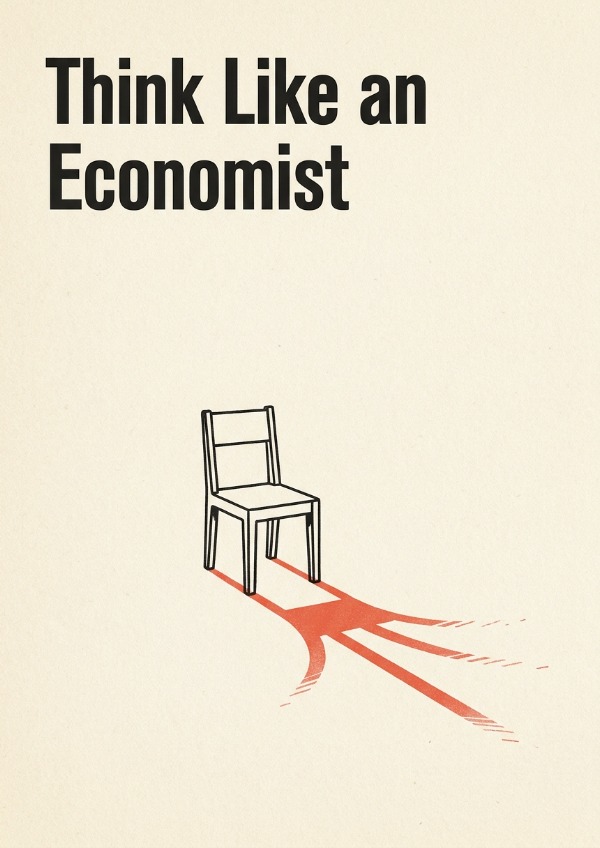
Think Like an Economist
Last revised 9/29/2026

Think Like an Economist

The portable toolkit for seeing what a choice really costs and what happens next

This collection reverse-engineers how economists think and hands it to you as a set of transferable mental models. It skips GDP accounting, monetary policy, and equations, and concentrates on the moves economists use to see any situation clearly: pricing a choice by what it displaces, predicting how people respond to the rules you set, reading prices as signals, following effects until the system settles, structuring games instead of just playing them, and testing all of it against evidence. Each session builds one model, from Bastiat and Ricardo to Ostrom, Akerlof, Roth, and the natural-experiment economists, and ends with a transfer note for your own career, team, pricing, or budget.

Mental OSToolkit
Earn4CreditsinEconomicsCritical Thinking
6Modules30Sessions346Cards89Quizzes

Modules in this Collection’s System

Scarcity and the True Cost of Choice

Every yes is a no to something else — the economist's starting point for every decision.

5Sessions

Incentives: The Hidden Wiring of Behavior

People respond to the rules they face — including the rules nobody meant to write.

5Sessions

Prices, Markets, and Signals

A price is compressed information — and markets are machines for spreading what no single person knows.

5Sessions

Seeing the Whole System

The first effect is rarely the last one — follow the chain until things settle.

5Sessions

Strategy and Interaction

When your best move depends on everyone else's, you're playing a game — so learn its structure.

5Sessions

The Model Meets the Real World

Models are maps — the skill is knowing which one fits the terrain, and how to test it against evidence.

5Sessions

What You'll Walk Away With

  • 5cost questions that expose what a decision really costs before you commit to it.
  • 5incentive diagnostics for predicting how people will respond to a target, guarantee, or pay scheme.
  • 4system-level tests — seen vs. unseen, equilibrium, incidence, and composition — for following effects past the first round.
  • 5game-structure levers for turning a race to the bottom into cooperation.
  • 1seven-question economist's checklist to run on any live decision.

You'll Have Answers To

  • ?Why does an hour-long meeting with eight people cost a full working day, and what else could that day have bought?
  • ?Why do targets that reward people so often end up rewarding the wrong thing?
  • ?If you are better at every task than your colleague, why do you both still gain when you specialize?
  • ?When a new fee lands on a deal, why does the person who can walk away most easily almost never pay it?
  • ?How did communities from Swiss alpine meadows to Japanese village forests keep shared resources healthy for centuries?

Critical Concepts Explored

Opportunity CostMarginal ThinkingSunk CostGoodhart's LawMoral HazardPrincipal–Agent ProblemComparative AdvantageAsymmetric InformationTax IncidenceMechanism Design
Editor's Note
“Economics without the equations: thirty models for seeing what a choice really costs and who responds.”

Instead of teaching the economy, this collection teaches the economist's way of looking at any decision. It moves from opportunity cost to mechanism design in one integrated toolkit, stays non-partisan on policy, and closes every model with a concrete use in a career, a team, or a budget.

Editor's Brief
Who it's for
Professionals, managers, founders, and curious readers who decide how to spend scarce time, money, and attention every day and want the sharp, portable tools economists use, without the equations.
What stands out
It pairs the classical toolkit — opportunity cost, marginal thinking, incentives, equilibrium — with game theory, information economics, mechanism design, behavioral economics, and natural experiments, and closes every model with a transfer note for the reader's own decisions.
Read if
Read it if you want to stop asking "is this good?" and start asking "compared to what, at what cost, and then what?"
Gold Quotes
The glazier's gain is easy to see. The shoes the shopkeeper never bought are not — and good decisions count both.

In 1850 Frédéric Bastiat described a broken shop window that the crowd called good for trade because it gave the glazier work. The six francs spent on glass would otherwise have bought shoes or a book, so the town was poorer by one window. Counting only what is seen is the most common error in economic reasoning.
About the Curator
TThink Like Great Minds

Think Like Great Minds is a LearningFirst original series that borrows the reasoning habits of world-class practitioners — analysts, mathematicians, investors, chief executives, economists — and translates them into transferable moves for anyone who has to think carefully when the answer isn't obvious. This collection treats economics as a way of seeing choices and systems, not as a profession.