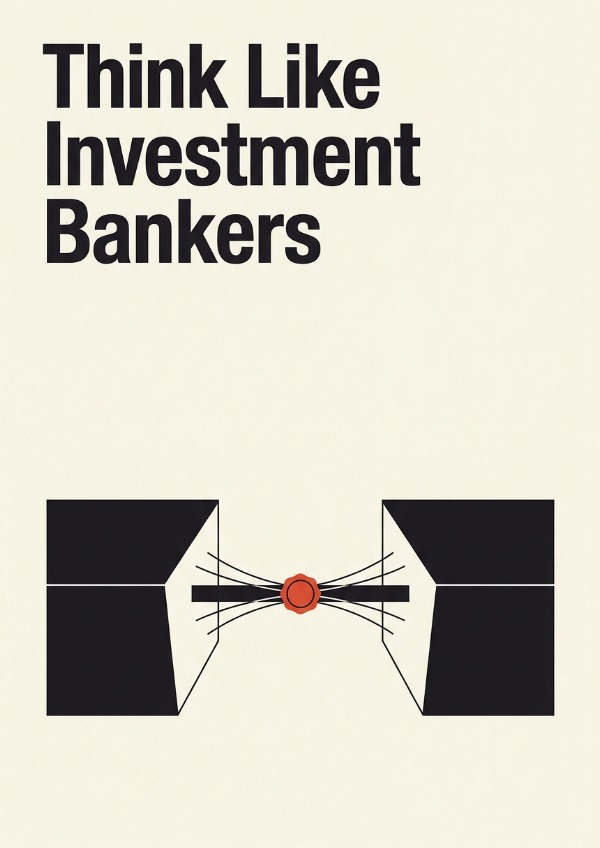
Think Like Investment Bankers
Last revised 9/29/2026

Think Like Investment Bankers

How professional intermediaries price, structure, and close the deals others can't

This collection reverse-engineers the thinking of great investment bankers and hands it to readers who will never work in a bank. It skips pitch-book formatting and modeling technicals and goes after the cognitive machinery underneath the profession: how intermediaries create value between parties, put a credible range on something that hasn't traded, design terms that turn disagreement into agreement, run a process that gets many parties to one signature, read when capital markets are open, and protect the trust that makes the whole franchise work. Drawing on figures from J. P. Morgan to Felix Rohatyn and thinkers such as Aswath Damodaran, Robert Bruner, and David Maister, every session ends with a transfer note for job offers, partnerships, fundraising, sales, and any negotiation over something valuable.
Mental OSDeal Toolkit
Earn4CreditsinFinanceBusiness Acumen
6Modules30Sessions296Cards60Quizzes

Modules in this Collection’s System

The Intermediary's Worldview

Value often lives between the parties — and the person who connects them well earns a lasting franchise.

5Sessions

Valuation: Pricing What Hasn't Traded

Value is a range, not a point — and it depends on who's buying.

5Sessions

Deal Architecture

Structure can matter more than price — terms turn disagreement into agreement.

5Sessions

Running the Process

Deals are won by process — competition, sequencing, controlled information, and momentum.

5Sessions

Markets, Timing, and Raising Capital

Capital markets have moods and windows — raise when you can, not only when you must.

5Sessions

The Banker's Discipline

Precision, preparation, and trust — the habits that make an advisor worth hiring.

5Sessions

What You'll Walk Away With

  • 5deal elements — parties, consideration, conditions, timeline, closing — for mapping any negotiation.
  • 3valuation lenses for putting a defensible range on anything that hasn't traded.
  • 4structuring levers — form, timing, contingency, and seniority — for bridging a gap in price.
  • 4process disciplines — competition, clock, staged disclosure, and closing plan — for getting to signature.
  • 1one-page deal plan for running your next offer, partnership, or purchase like a banker.

You'll Have Answers To

  • ?How did J. P. Morgan stop a financial panic in 1907 with no official authority at all?
  • ?Why is the same company worth different amounts to different buyers — and how do you find the one who values it most?
  • ?When two sides can't agree on a price, which terms let each of them bet on its own view of the future?
  • ?Why do experienced bankers insist on a second credible bidder before they negotiate seriously?
  • ?When is the most valuable advice an advisor can give simply: don't do this deal?

Critical Concepts Explored

Transaction ThinkingReputation CapitalValuation TriangulationFootball Field RangeContingent ConsiderationThe Capital StackCompetitive TensionControlled DisclosureMarket WindowsThe Trusted Advisor
Editor's Note
“The banker's craft of pricing, structuring, and closing — made portable for anyone who negotiates.”

Rather than explain how the industry works, this collection extracts how its best practitioners think: valuation as a range, structure as the tool that bridges disagreement, process as the source of leverage. Its closing module on conflicts and candid advice keeps the deal-making honest.

Editor's Brief
Who it's for
Founders, operators, managers, and business-development professionals who negotiate offers, raise capital, price their work, or broker partnerships, with no finance background assumed.
What stands out
It treats valuation as a way of reasoning in ranges rather than a spreadsheet, gives deal structure and process as much weight as price, and pairs every deal-making move with the trust that keeps an advisor worth hiring.
Read if
Read it if you have ever argued only about the headline number and later realized the terms, the timing, or the other options decided the outcome.
Gold Quotes
Most people negotiate a price. Bankers negotiate a structure, and the structure decides what the price is actually worth.

Cash now, stock later, a fixed sum or a payment tied to milestones: two offers with the same headline number can differ enormously in value and risk. By changing the form and timing of payment, a deal that stalls on price can often be closed on terms both sides prefer.

About the Curator
TThink Like Great Minds

Think Like Great Minds is a LearningFirst original series that borrows the reasoning habits of world-class practitioners — analysts, mathematicians, investors, chief executives, bankers — and translates them into transferable moves for anyone who has to think carefully when the answer isn't obvious. This collection treats investment banking as a way of thinking about deals, not as a career.