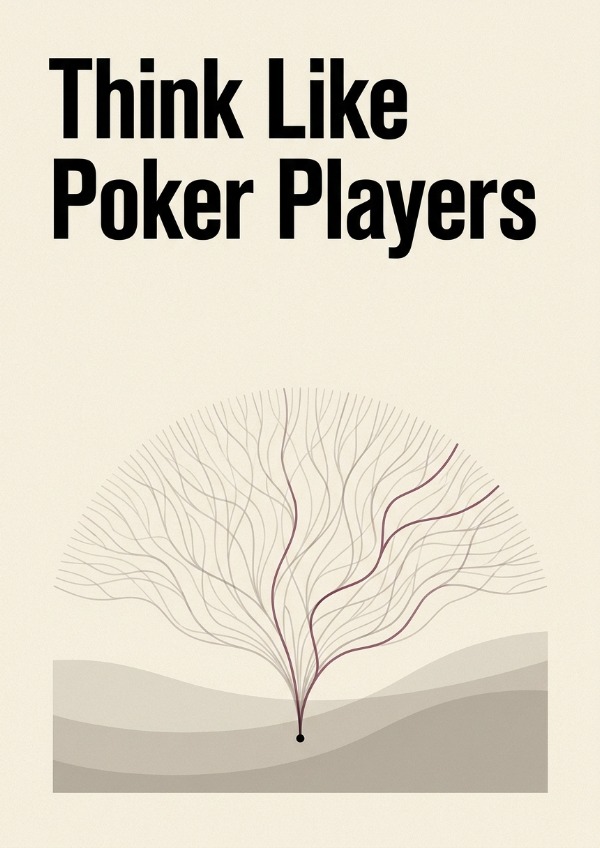
Think Like Poker Players
Last revised 10/8/2026

Think Like Poker Players

Decision-making under uncertainty, from the discipline with the most honest feedback

Poker is a laboratory for decision-making under uncertainty: incomplete information, real stakes, and feedback so blunt that no one can hide from their results for long. This collection strips out the cards and chips and keeps the thinking — the separation of decision quality from outcome quality, the habit of reasoning in ranges and expected value, the discipline of sizing bets so a bad run never ends the game, the inner work of managing tilt and ego, and the recursive strategy that emerges when the other side is thinking too. Each session isolates one transferable mental model and aims it at business, career, and life decisions. You finish with a decision framework built for any setting where you act on partial information and live with probabilistic results.

Mental OSDecision Lab
Earn4CreditsinCritical ThinkingBusiness Acumen
6Modules30Sessions335Cards90Quizzes

Modules in this Collection’s System

The Poker Player's Worldview

The foundational shifts in how poker players see decisions, luck, and skill — before they play a single hand.

5Sessions

Thinking in Ranges

How poker players replaced "what do they have?" with "what could they have?" — and why thinking in distributions changes everything.

5Sessions

Information and Position

What you know, when you know it, and what your own actions are saying to everyone else at the table.

5Sessions

Risk, Ruin, and Survival

Bankroll management as a universal framework for sizing bets, surviving bad runs, and staying in the game long enough to win.

5Sessions

The Mental Game

Tilt, ego, discipline, and the inner game that separates professionals from talented amateurs in every field.

5Sessions

Strategy and Adaptation

Bluffing, balancing, levels of thinking, and the recursive game that emerges when your opponent is also thinking about what you're thinking.

5Sessions

What You'll Walk Away With

  • 1decision-quality audit for judging a choice by its information, reasoning, and odds instead of how it turned out.
  • 5probabilistic reasoning tools — ranges, expected value, pot odds, belief updating, and calibration — for deciding before the evidence is complete.
  • 4bet-sizing and survival rules for taking risks with an edge without risking ruin.
  • 3mental-game diagnostics for spotting tilt, ego leaks, and a slipping C-game before they cost you.
  • 2strategic modes — balanced and exploitative — for competing against people who are also thinking about you.

You'll Have Answers To

  • ?If a good decision can lose and a bad decision can win, how do you tell whether you are actually getting better?
  • ?Why do professionals ask "what could they have?" instead of "what do they have?" — and what changes when you forecast in ranges instead of single answers?
  • ?How can a strategy with a genuine edge still bankrupt you, and how much should you risk on any single bet?
  • ?What is tilt, and why does it shift your decision criteria without you ever noticing?
  • ?When should you play a balanced, unexploitable strategy — and when should you attack one opponent's specific weakness?

Critical Concepts Explored

Decision vs. OutcomeResultingRange ThinkingExpected ValueCalibrationPositionTable SelectionRisk of RuinKelly CriterionTilt
Editor's Note
“Poker's hard-won decision science, with the felt stripped away and the thinking left intact.”

Rather than teaching the game, this collection extracts the mental models professional players built under unforgiving feedback — resulting, range thinking, risk of ruin, tilt, and exploitative versus balanced play — and aims each one at business and career decisions. Its modules on bankroll survival and the mental game are unusually practical.

Editor's Brief
Who it's for
Strategists, founders, investors, managers, and intellectually curious professionals who make consequential decisions with incomplete information and want a framework for judging those decisions honestly.
What stands out
It extracts the thinking that professional poker refined under brutally honest feedback — decision quality versus outcome, ranges and expected value, bankroll survival, tilt control, and adaptive strategy — and applies each model directly to business, career, and life decisions, with no hand histories or pot-odds drills.
Read if
Read it if you have ever been praised for a lucky result or blamed for a sound call that went wrong, and you want a precise way to separate the quality of your decisions from the luck in your outcomes.
Gold Quotes
A good decision can lose and a bad decision can win — and anyone who grades choices by their results is learning from luck.

Poker players separate the quality of a decision from the quality of its outcome because the game punishes anyone who doesn't. One hand tells you almost nothing; only the pattern across many decisions reveals skill. Businesses that reward lucky outcomes and punish unlucky sound calls end up training their people to repeat the wrong things.
About the Curator
TThink Like Great Minds

Think Like Great Minds is a LearningFirst original series that borrows the reasoning habits of world-class practitioners — analysts, mathematicians, investors, strategists — and translates them into transferable moves for anyone who has to think carefully when the answer isn't obvious. This collection treats poker as a school for decisions under uncertainty, with the card game itself left on the table.