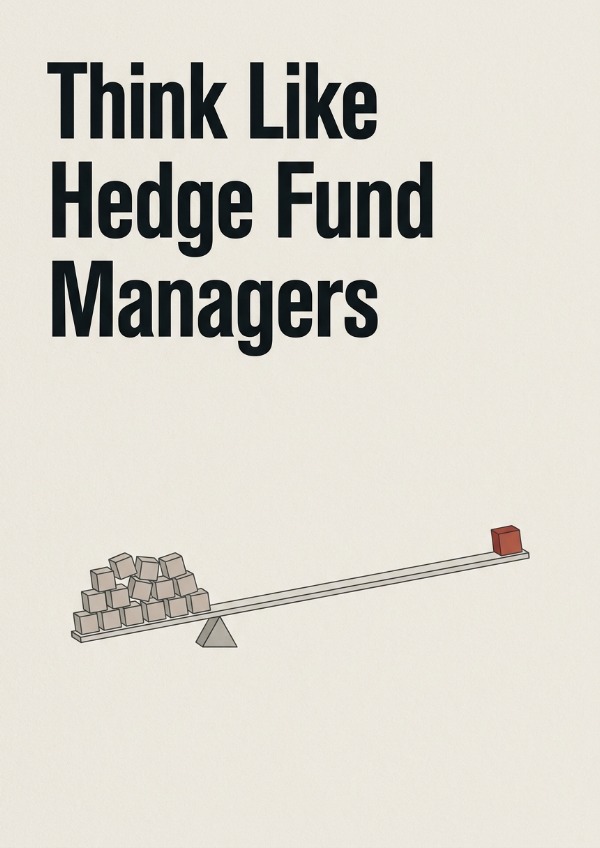
Think Like Hedge Fund Managers
Last revised 9/29/2026

Think Like Hedge Fund Managers

How elite discretionary investors find an edge, size conviction, and survive being wrong

This collection reverse-engineers the thinking of the best discretionary hedge fund managers and hands it to you as a transferable toolkit for decisions far outside finance. It is built around one formula — edge × sizing × survival — across six modules on finding an edge, positioning and sizing, risk and survival, reading cycles and crowds, running a decision process, and building an investment operation, with one mental model per session drawn from investors such as George Soros, Stanley Druckenmiller, Michael Steinhardt, Paul Tudor Jones, Howard Marks, and Ray Dalio. Famous wins and famous failures, from Black Wednesday in 1992 to the near-collapse of Long-Term Capital Management in 1998, are treated as equally instructive. Every session ends with a transfer note that applies the model to a career, a business, or a personal decision. You finish able to form an independent view, commit to it in proportion to the evidence, and stay in the game long enough for good judgment to pay off.

Mental OSDiscipline
Earn4CreditsinFinanceCritical Thinking
6Modules30Sessions341Cards90Quizzes

Modules in this Collection’s System

Finding an Edge

An edge is a specific, defensible reason to believe you see something the crowd hasn't priced in.

5Sessions

Positioning and Sizing

Being right is half the job — how much you commit determines what your insight is worth.

5Sessions

Risk and Survival

The first rule is to stay in the game — every edge needs time to pay off.

5Sessions

Reading Cycles and Crowds

Markets are made of people — their beliefs move prices, and prices move beliefs.

5Sessions

The Decision Process

Judgment improves when you write it down, review it honestly, and manage your own mind.

5Sessions

Building an Investment Operation

Scaling judgment means allocating risk to people, knowing what you're paid for, and aligning with your capital.

5Sessions

What You'll Walk Away With

  • 4types of edge — informational, analytical, behavioral, and structural — for testing whether you see something others have missed.
  • 5sizing principles for committing in proportion to conviction, asymmetry, and your ability to exit.
  • 5survival rules for staying in the game when a view turns out to be wrong.
  • 4market-reading lenses — reflexivity, crowding, liquidity, and cycle position — for judging what everyone else believes.
  • 1six-question decision memo for running any live decision through edge, expectations, catalyst, size, exit, and survival.

You'll Have Answers To

  • ?Why did George Soros tell Stanley Druckenmiller that a large bet against the British pound was too small?
  • ?How did a fund staffed by celebrated traders and Nobel-winning economists nearly collapse in 1998 — and why does survival come before return?
  • ?If everyone already agrees with you, where exactly is the opportunity?
  • ?When do rising prices start creating the very fundamentals that seem to justify them?
  • ?How much of your recent success came from favorable conditions, and how much came from skill?

Critical Concepts Explored

Variant PerceptionCatalystMosaic TheoryPosition SizingAsymmetric PayoffDrawdown ArithmeticReflexivityCrowded TradeIdea MeritocracyAlpha vs. Beta
Editor's Note
“Hedge-fund thinking without the trading — edge, sizing, and survival rebuilt as tools for any consequential decision.”

Most writing on investing celebrates the winning call. This collection gives equal weight to the two questions that decide outcomes — how much to commit and how to survive being wrong — anchored in cases from Black Wednesday to Long-Term Capital Management. Every session closes with a concrete way to use the model outside markets.

Editor's Brief
Who it's for
Professionals, founders, managers, individual investors, and curious readers who make high-stakes calls under uncertainty and want the mental models elite discretionary investors use — no finance background assumed.
What stands out
It gives risk and survival the same weight as idea generation, draws one way of thinking across long/short, global macro, event-driven, and multi-manager styles, and treats famous failures like Long-Term Capital Management as seriously as famous wins.
Read if
Read it if you are often right about the big picture but unsure how much to commit, or slow to admit when a view has stopped working.
Gold Quotes
Being right matters less than how much you make when you are right and how much you lose when you are wrong.

In September 1992 Stanley Druckenmiller, managing money for George Soros, planned a large position against the British pound, and Soros judged it too small for the strength of the analysis. On Black Wednesday, 16 September, Britain left the European Exchange Rate Mechanism and the fund earned about a billion dollars. Druckenmiller has called that sizing lesson the most important thing Soros taught him.

About the Curator
TThink Like Great Minds

Think Like Great Minds is a LearningFirst original series that borrows the reasoning habits of world-class practitioners — analysts, mathematicians, investors, chief executives — and translates them into transferable moves for anyone who has to think carefully when the answer isn't obvious. This collection treats the hedge fund manager's craft as a way of forming independent views and committing to them under uncertainty, not as a guide to trading.