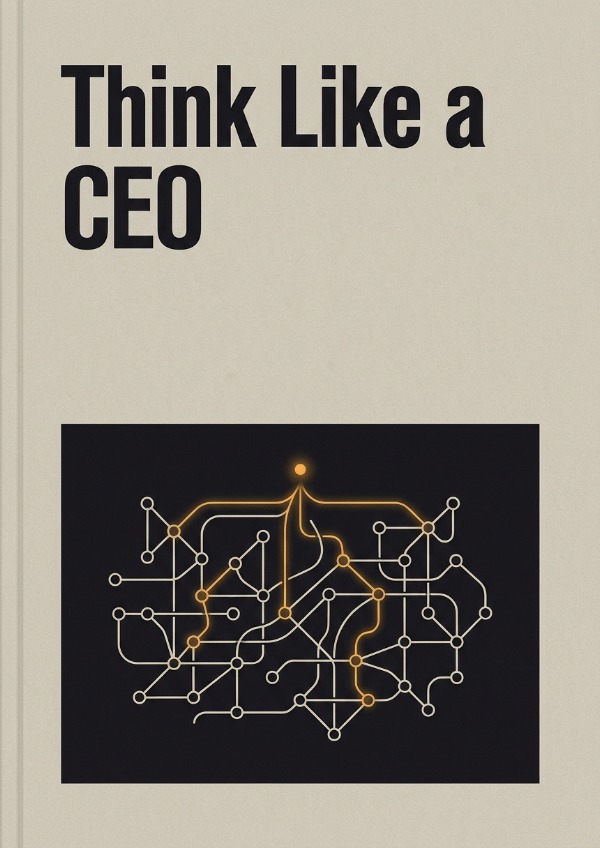
Think Like a CEO
Last revised 9/29/2026

Think Like a CEO

How the people who own the whole choose, allocate, select, and decide

This collection reverse-engineers the thinking behind great chief executives and hands it to you as a transferable toolkit. It is built around the handful of decisions that only the top role makes — setting direction, allocating capital, choosing people, designing culture and operating rhythms, and judging under pressure — with one mental model per session, drawn from leaders such as Andy Grove, Henry Singleton, Katharine Graham, Alan Mulally, Satya Nadella, and Indra Nooyi. Every session ends with a transfer note that scales the model down to a team, a project, or a career. You finish able to run any scope you own the way a strong CEO runs a company.

Mental OSPlaybook
Earn4CreditsinManagementBusiness Acumen
6Modules30Sessions305Cards60Quizzes

Modules in this Collection’s System

The Job Only One Person Has

Every other role optimizes a part — the CEO is accountable for the whole, and that changes how you think.

5Sessions

Strategy: Choosing Where to Play

Strategy is a coherent set of choices — including the valuable things you decide not to do.

5Sessions

Capital Allocation

Every CEO is an investor — the budget is the strategy made real.

5Sessions

People: The Leverage of Selection

Choosing who decides is the decision that shapes every other decision.

5Sessions

Culture and the Operating System

Culture is how the organization behaves when the CEO isn't watching — and mechanisms make it last.

5Sessions

Judgment Under Pressure

When the stakes are highest, the CEO's clarity becomes the organization's clarity.

5Sessions

What You'll Walk Away With

  • 5non-delegable decisions that define the job of owning the whole.
  • 5capital allocation options to compare before the next dollar or hour is committed.
  • 4people levers — selection, team design, the bar, and decision rights — for multiplying your judgment.
  • 3operating mechanisms — cadence, metrics, and repetition — that make strategy run without you.
  • 1one-page CEO memo for running your own team, project, or career as its chief executive.

You'll Have Answers To

  • ?Why did Andy Grove have to imagine being fired before Intel could make the move that saved it?
  • ?If the budget is the real strategy, what does yours say you actually believe?
  • ?Why do the CEOs with the best long-term records spend so much time on capital allocation and so little on vision statements?
  • ?Why does bad news travel slowest to the one person who most needs to hear it — and how do great leaders fix that?
  • ?Which decisions should you make fast on 70% of the information, and which ones deserve every hour you can give them?

Critical Concepts Explored

Managerial LeverageNon-Delegable DecisionsStrategic Inflection PointKernel of Good StrategyCapital AllocationResource ReallocationTalent DensityTask-Relevant MaturityMechanisms over IntentionsOne-Way and Two-Way Doors
Editor's Note
“The CEO's job, reduced to the decisions no one else can make — and handed to the rest of us.”

Rather than generic leadership advice, this collection isolates the calls that belong only to whoever owns the whole: direction, capital, people, operating rhythm, and judgment under pressure. Its section on capital allocation is unusually strong, and every session closes with a concrete way to use the model at your own scale.

Editor's Brief
Who it's for
Founders, managers, team leads, and ambitious professionals who own an outcome larger than their own work and want the specific mental models strong CEOs use.
What stands out
It narrows CEO thinking to the decisions only the top role makes — with a full module on capital allocation, the least discussed and most consequential of them — and scales every model down to a team, a project, or a career.
Read if
Read it if you have been handed responsibility for the whole of something and suspect that working harder on the parts is no longer the job.
Gold Quotes
If a new CEO would get out of your failing business on day one, the only question left is why you haven't already.

In 1985 Andy Grove asked Gordon Moore what a replacement CEO would do about Intel's collapsing memory business. Moore said get out of memories. Grove proposed they walk out the door, come back in, and do it themselves — and Intel bet the company on microprocessors.
About the Curator
TThink Like Great Minds

Think Like Great Minds is a LearningFirst original series that borrows the reasoning habits of world-class practitioners — analysts, mathematicians, investors, chief executives — and translates them into transferable moves for anyone who has to think carefully when the answer isn't obvious. This collection treats the CEO's job as a way of thinking about the whole, not as a title.

Think Like a CEO | LearningFirst