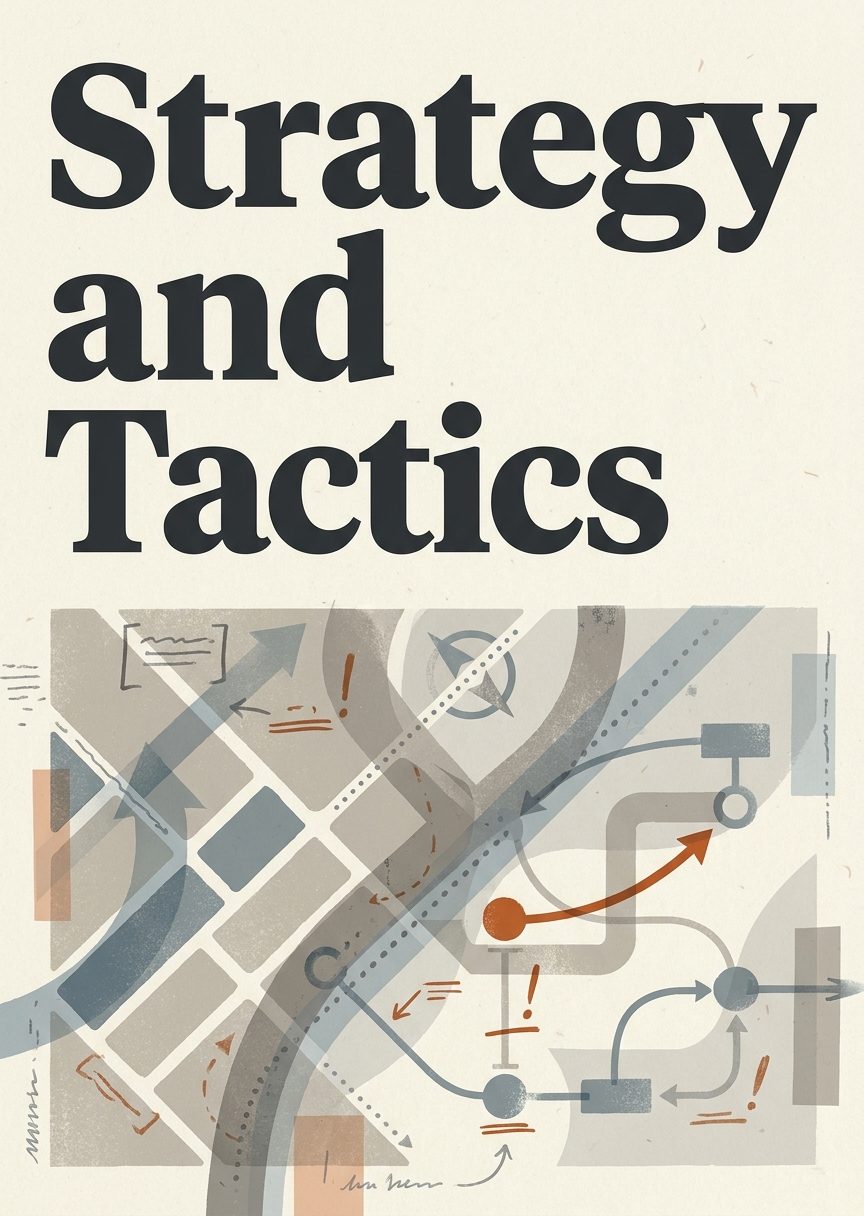
Strategy and Tactics
Last revised 10/9/2026

Strategy and Tactics

Why organizations fail when they confuse the two — and how to tell which mode you are in.

Every organization operates on two levels simultaneously. Strategy sets direction: which markets to enter, which capabilities to build, what to say no to. Tactics execute: the quarterly plan, the budget allocation, the hiring decision, the product sprint. The distinction is one of the oldest in organized human activity and one of the most frequently mangled. A CEO who spends board meetings reviewing expense reports is doing tactics in a strategy seat. A project manager who reimagines the company's competitive position mid-sprint is doing strategy in a tactics seat. This collection diagnoses the boundary between the two, maps the specific failure patterns that emerge when the levels are confused — strategic drift, the activity trap, the McNamara Fallacy — and builds a repeatable diagnostic practice for reading which mode an organization is actually operating in. The cases span Clausewitz and Sun Tzu's military origins through Chandler, Porter, Mintzberg, Rumelt, Christensen, and Grove, with the centre of gravity firmly in organizational and business contexts.

DiagnosticField Guide
Earn4.12CreditsinManagementBusiness Acumen
6Modules30Sessions300Cards83Quizzes

Modules in this Collection’s System

What Strategy and Tactics Actually Mean

The distinction's origins, what it names, and why organizations keep blurring it.

5Sessions

The Mechanics of Strategic Thinking

What strategic thinking involves — diagnosis, choice, resource allocation, and the limits of foresight.

5Sessions

The Mechanics of Tactical Execution

What makes execution effective, and why it is a discipline rather than a personality trait.

5Sessions

The Handoff

Where strategic intent either translates into tactical action or quietly dies.

5Sessions

Failure Patterns

The recurring ways organizations fail by putting strategy in the tactics seat or tactics in the strategy seat.

5Sessions

Diagnosing the Organization

Reading which mode a decision belongs to and building the discipline to stay there.

5Sessions

What You'll Walk Away With

  • 5failure-pattern labels (strategic drift, activity trap, tactical brilliance / strategic bankruptcy, strategy by spreadsheet, McNamara Fallacy) for diagnosing organizational pathology
  • 3diagnostic tests (meeting test, horizon test, reversibility test) for routing any decision to the right level
  • 1strategy kernel (Rumelt's diagnosis, guiding policy, coherent action) for testing whether a document is a strategy or a wish list
  • 1resource-allocation audit for comparing where money and attention actually go against the stated strategy
  • 5quarterly diagnostic questions that catch strategy-tactics mismatches before they become drift

You'll Have Answers To

  • ?What is the real distinction between strategy and tactics, and why does it matter that most organizations blur it?
  • ?If resource allocation is the revealed strategy, what strategy is the organization actually pursuing — regardless of what the plan says?
  • ?Where in the organization does strategic intent die on its way to tactical execution, and who owns the handoff?
  • ?What are the specific, recurring patterns that emerge when an organization puts strategy in the tactics seat or tactics in the strategy seat?
  • ?How does a manager learn to see which level a decision belongs to and build the discipline to stay there?

Critical Concepts Explored

Strategy-Tactics BoundaryRumelt's Strategy KernelEmergent StrategyResource-Allocation AuditStrategic Inflection PointTheory of ConstraintsOODA LoopStrategic DriftActivity TrapMcNamara Fallacy
Editor's Note
“A diagnostic field guide for reading which level an organization is actually operating on.”

The collection treats strategy and tactics as complementary disciplines rather than a hierarchy, and focuses on the handoff zone where most organizational failures actually occur. Every session names specific people, organizations, and cases — Rumelt's kernel, Christensen's resource-allocation insight, Mintzberg's emergent strategy, the McNamara Fallacy — and the capstone builds a repeatable diagnostic practice from the accumulated tools.

Editor's Brief
Who it's for
Mid-career managers, directors, VPs, founders, and consultants who make or influence resource-allocation decisions — people who have experienced the gap between a strategy presentation and what actually happens afterward, and want the structural vocabulary to diagnose where the machinery breaks.
What stands out
It diagnoses how organizations confuse the two levels rather than teaching how to write a strategic plan. The handoff zone — where strategic intent either gains traction or quietly dies — is the collection's distinctive subject, and the capstone builds five diagnostic tests into a repeatable quarterly practice.
Read if
Read if the last strategy presentation at the organization produced a plan that changed nothing, and the question is why.
Gold Quotes
Strategy chooses the game. Tactics plays the hand. Confuse the two and the organization does neither.

Clausewitz separated the two in 1832: strategy is the plan for the campaign; tactics is the conduct of the battle. Porter sharpened the line in 1996: operational effectiveness — doing the same things better — is not strategy. Strategy is choosing different activities, or performing similar activities differently, to create a unique position. Southwest Airlines did not execute the traditional airline model better; it chose a fundamentally different set of activities that reinforced each other.

About the Curator
TThe Lever

The Lever is a LearningFirst original channel that examines the structural mechanisms behind organizational decisions — the forces, incentives, and design choices that determine whether an organization achieves what it intends. Strategy and Tactics is its diagnostic investigation of the most studied and least solved boundary in management.