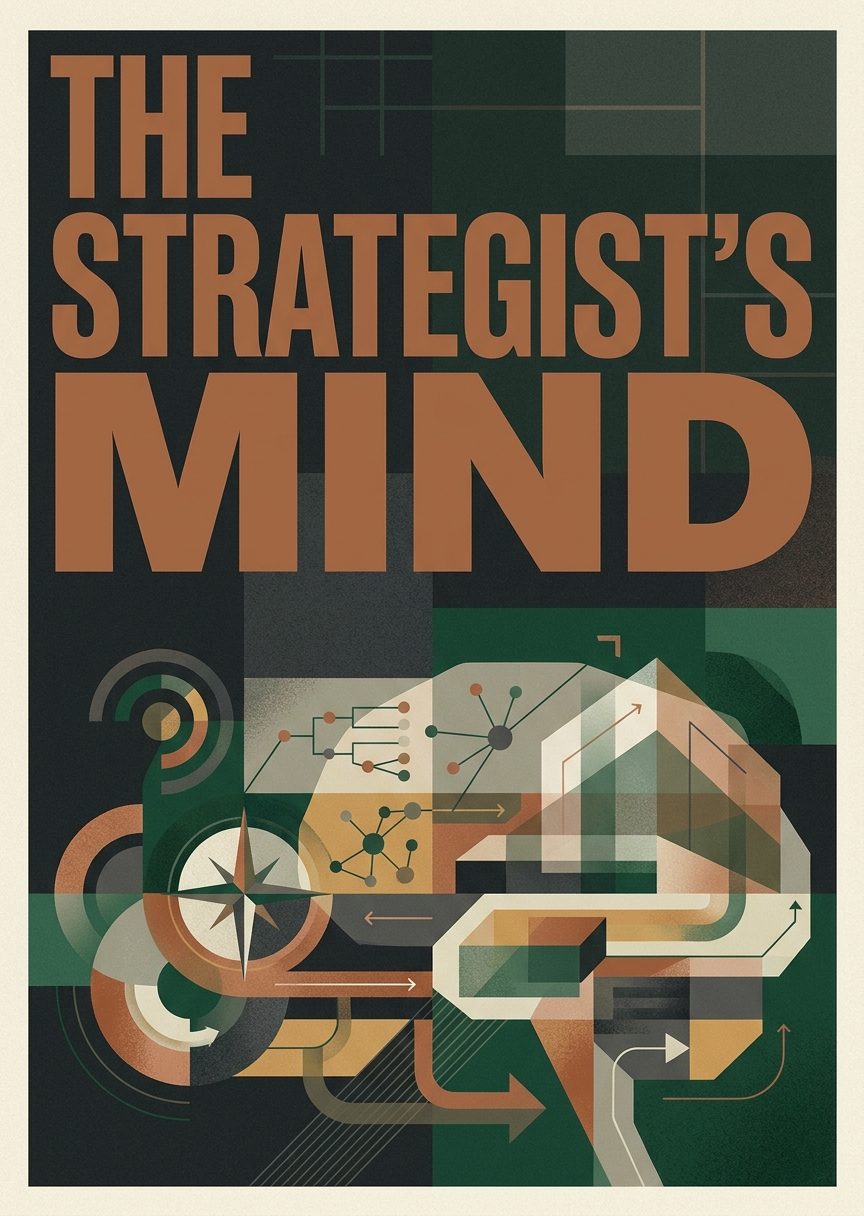
The Strategist's Mind
Last revised 10/4/2026

The Strategist's Mind

Mental models from history's greatest competitive thinkers — organized by principle, not person

Every competitive situation — a market entry, a negotiation, a career pivot — is a problem of incomplete information, limited resources, and an opponent who is also thinking. This collection assembles the strategic mental models of history's most influential competitive thinkers — Sun Tzu, Clausewitz, Boyd, Machiavelli, Thucydides, Napoleon, Hannibal, Alexander, Liddell Hart, Mao, Musashi, and modern strategists like Freedman and Greene — and extracts the transferable thinking principle each one contributes. The historical case is the anchor; the mental model is the payload.

ToolkitParadigm
Earn4.87CreditsinStrategic Thinking
7Modules34Sessions337Cards94Quizzes

Modules in this Collection’s System

What Strategy Is

The foundations — what strategy actually means, how it differs from planning, and why a thinking opponent changes everything

5Sessions

Information and Deception

The decisive advantage of knowing the opponent's position while concealing your own

5Sessions

Friction, Fog, and Uncertainty

Operating when the situation is unclear, plans collapse, and chance keeps intervening

5Sessions

Tempo, Initiative, and Decisive Action

When speed wins, how to seize the initiative, and the conditions under which commitment beats deliberation

5Sessions

Asymmetry and the Indirect Approach

How weaker competitors defeat stronger ones by refusing to fight on the stronger side's terms

5Sessions

Power, Politics, and Grand Strategy

Competitive means must serve political ends — understanding power dynamics as the prerequisite for strategic action

4Sessions

The Strategist's Toolkit

Selecting the right mental model for the situation at hand — and building strategic thinking as a lifelong practice

5Sessions

What You'll Walk Away With

  • 7strategic lenses for reading competitive situations — from information warfare to power transitions
  • 12+historical case studies analyzed for transferable competitive principles
  • 5diagnostic frameworks for matching the right mental model to the problem at hand
  • 3tempo-judgment heuristics for knowing when speed beats deliberation and when patience wins
  • 4asymmetric strategies available to competitors who cannot match the opponent's resources

You'll Have Answers To

  • ?What separates strategy from planning, and why does the distinction matter in every competitive domain?
  • ?How do strategists operate when the information is incomplete, the plan is collapsing, and chance keeps intervening?
  • ?When does speed win, and when does patience outperform decisive action?
  • ?How does a weaker competitor defeat a stronger one without matching their resources?
  • ?How does a strategist select the right mental model for the situation at hand — and avoid applying the wrong one?

Critical Concepts Explored

Friction (Clausewitz)Fog of WarOODA Loop (Boyd)Indirect Approach (Liddell Hart)Coup d'Oeil — Trained Strategic IntuitionRemarkable TrinityStrategy of the Central PositionProtracted War (Mao)Thucydides TrapVirtù (Machiavelli)Antifragile Positioning
Editor's Note
“A structured toolkit of competitive mental models, organized by the type of problem they solve.”

This collection treats strategic thinking as a transferable discipline, not a military history survey. Each session extracts one mental model from a historical strategist, grounds it in a concrete case, and shows where it applies — and where it fails — in modern competitive contexts. The result is a diagnostic repertoire, not a reading list.

Editor's Brief
Who it's for
Professionals, founders, managers, and analysts who operate in competitive environments and want structured mental models for adversarial reasoning — no military background assumed.
What stands out
Organized by principle, not person or period — each module addresses a different type of competitive problem (information, uncertainty, tempo, asymmetry, power), so the reader builds a conceptual map rather than a timeline.
Read if
Read if the last time a competitor surprised you, your first instinct was to react rather than diagnose what kind of problem you were actually facing.
Gold Quotes
The strategist's real skill is not mastering one framework but knowing which lens fits which situation.

Sun Tzu's emphasis on deception is powerful when the opponent is stronger; it is inadequate when speed and decisive commitment are what the moment demands. Boyd's OODA loop prizes tempo above all; Clausewitz warns that tempo without political purpose is motion without meaning. The skill is switching lenses fast enough to stay ahead.
About the Curator
TThinking Paradigms

Thinking Paradigms is LearningFirst's channel for structured mental models — collections that install new ways of seeing a problem, organized by the type of thinking they train rather than the domain they come from.