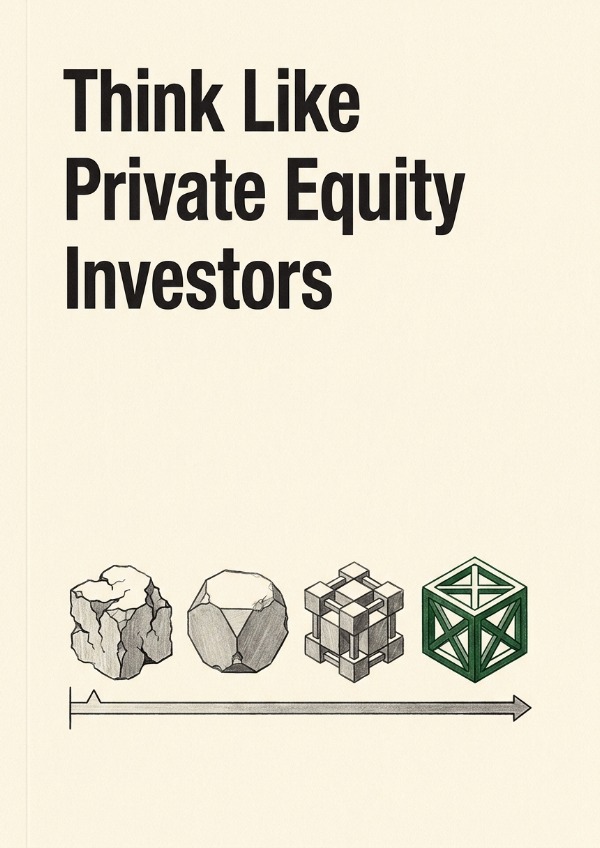
Think Like Private Equity Investors
Last revised 9/29/2026

Think Like Private Equity Investors

Ownership thinking with a deadline: buy well, build value, exit on purpose

This collection reverse-engineers how the best private-equity investors think and hands it to you as a transferable toolkit. It follows the life of a deal — owning the outcome, judging what to buy and what to pay, using debt and incentives with discipline, improving the business, holding through a downturn, and exiting on purpose — with one mental model per session, drawn from KKR, Blackstone's Hilton investment, Constellation Software, Danaher, and the research of Michael Jensen and Steven Kaplan. Every session ends with a transfer note that scales the model down to a team, a turnaround, a family business, or a career. No finance background is assumed, and nothing here is investment advice: the subject is the thinking.

Mental OSOwner's Playbook
Earn4CreditsinFinanceBusiness Acumen
6Modules30Sessions329Cards90Quizzes

Modules in this Collection’s System

The Owner's Mindset

Owning a business for a defined period changes every question you ask about it.

5Sessions

Finding and Judging Deals

Great returns start with what you buy and what you pay — and the discipline to walk away.

5Sessions

Structure, Leverage, and Alignment

Financing and incentives shape behavior — design them to make the plan achievable.

5Sessions

Creating Value

The best returns come from making the business genuinely better.

5Sessions

Holding Through Change

Plans meet reality — the owner's job is to adapt without losing the thesis.

5Sessions

Exits and the Long View

Finishing well is part of the plan — and the owner's mindset applies far beyond deals.

5Sessions

What You'll Walk Away With

  • 1one-page investment thesis format for any initiative, deal, or career plan.
  • 3sources of return to separate what you improved from what the conditions gave you.
  • 5operating levers owners pull to make a business genuinely better.
  • 4exit routes to weigh before committing to a role, project, or company.
  • 4-step turnaround sequence for stabilizing anything that is failing.

You'll Have Answers To

  • ?Why would a disciplined investor decide how to sell a company before agreeing to buy it?
  • ?How did Blackstone turn a buyout that looked like a disaster in 2008 into one of the most profitable deals on record?
  • ?When a result looks good, how much of it did you create — and how much did the market hand you?
  • ?Why can the same amount of debt discipline one business and destroy another?
  • ?How do you know when the best thing you can do for something you built is to hand it to someone else?

Critical Concepts Explored

Investment ThesisValue Creation BridgeIRR vs. Multiple of MoneyQuality of EarningsWalk-Away PriceLeverage HeadroomFree Cash Flow100-Day PlanBuy-and-BuildEquity Story
Editor's Note
“Private equity stripped of its mystique and rebuilt as a plan for improving anything you own.”

This collection skips fund mechanics and modeling to isolate how disciplined owners think: plan the exit first, pay the right price, finance for the bad year, improve the business, hold through trouble. The module on operational value creation is the strongest, and every session ends with a concrete transfer.

Editor's Brief
Who it's for
Operators, general managers, founders, family-business owners, and consultants who are responsible for improving something within a timeframe and want the disciplined value-creation habits of private-equity owners — no finance background needed.
What stands out
It follows one deal from purchase to exit and gives operational value creation a full module of its own, then translates every model — the one-page thesis, price discipline, leverage headroom, the 100-day plan, the exit — into a move for a team, a turnaround, or a career.
Read if
Read it if you have been handed something to improve within a few years and want to plan the ending as carefully as the beginning.
Gold Quotes
Private-equity thinking is ownership thinking with a deadline: know the ending you want before you decide what to do on day one.

A buyout fund owns a company for roughly four to seven years and must sell it at the end. That deadline forces a value-creation plan with a few named levers and a clear buyer in mind — the same discipline any team lead, founder, or career-changer can borrow.
About the Curator
TThink Like Great Minds

Think Like Great Minds is a LearningFirst original series that borrows the reasoning habits of world-class practitioners — analysts, mathematicians, investors, chief executives — and translates them into transferable moves for anyone who has to think carefully when the answer isn't obvious. This collection treats private equity as a discipline of owning and improving something within a timeframe, not as a corner of high finance.