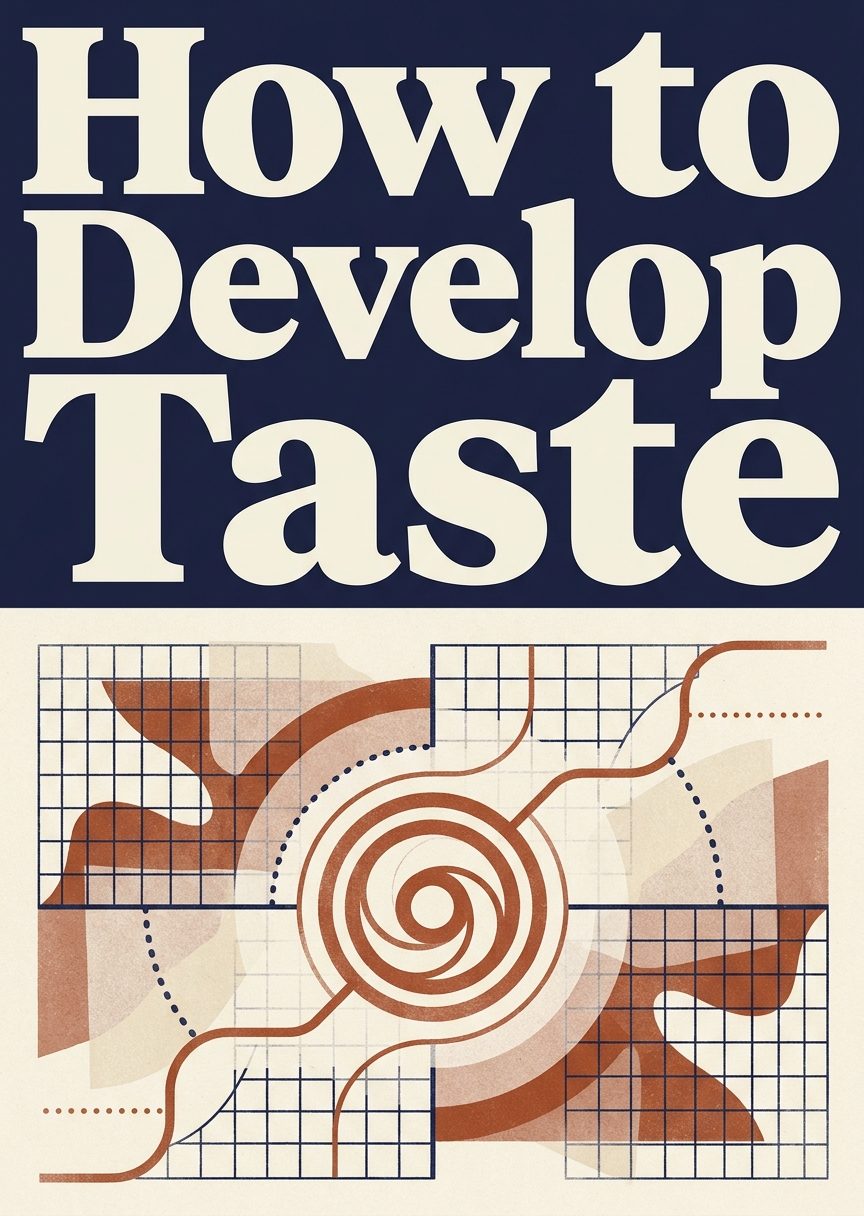
How to Develop Taste
Last revised 10/8/2026

How to Develop Taste

The four-stage framework for building informed judgement in any domain — and why taste is the scarce skill in an AI-saturated world

Taste is the capacity to distinguish good from not-good within a domain — and to articulate why. It follows a developmental sequence that repeats across every field: accumulate experience, criticise and compare, identify patterns, and name what you find. In an era where AI can produce infinite content, the bottleneck shifts from creation to selection — and selection is taste.

Meta-SkillFramework
Earn3CreditsinCritical ThinkingDesign
5Modules25Sessions256Cards74Quizzes

Modules in this Collection’s System

What Taste Is

The anatomy of an underrated capacity — what taste means, how it differs from preference, and why it is a skill.

5Sessions

Why Taste Matters Now

The economics of infinite content — why taste is the capacity that separates signal from noise when production costs hit zero.

5Sessions

How Taste Develops

The four-stage framework: accumulate experience, criticise and compare, extract patterns, and articulate what you find.

5Sessions

Taste Across Domains

How the same developmental process produces taste in food, design, writing, and music — what transfers and what does not.

5Sessions

The Taste Project

A structured framework for developing taste in a chosen domain — from selecting a category to articulating a defensible position.

5Sessions

What You'll Walk Away With

  • 5anatomy sessions — what taste is, how it differs from preference and opinion, why vocabulary creates perception
  • 5urgency arguments — the abundance problem, AI's judgement gap, curation as creation, the taste gap, taste as career skill
  • 5developmental stages — experience widely, criticise and compare, find patterns, name it, and why the cycle never ends
  • 5domain studies — taste in food, visual design, writing, music, and what transfers between fields
  • 5project framework sessions — choose domain, experience phase, criticism phase, pattern phase, articulation

You'll Have Answers To

  • ?What is the difference between preference, opinion, and taste — and why does that distinction matter?
  • ?Why does taste follow a four-stage developmental sequence that repeats across every domain?
  • ?Why does AI-generated abundance make taste the most valuable human skill — and what exactly is the taste gap?
  • ?What transfers when you move from one domain to another — and what has to be rebuilt from scratch?
  • ?How does articulation change taste — why is naming what you notice not just a report but part of the development?

Critical Concepts Explored

Taste as SkillPreference vs Opinion vs TasteThe Vocabulary ProblemThe Abundance ProblemCuration as CreationThe Four-Stage FrameworkDomain TransferThe Taste GapArticulation as RefinementThe Cycle Never Ends
Editor's Note
“The taste course that treats quality judgement as a trainable skill, not an innate gift.”

Most people treat taste as something you either have or you don't. This collection dismantles that assumption — presenting a four-stage developmental framework that builds informed judgement in any domain, and showing why taste becomes the decisive human skill when AI makes production free.

Editor's Brief
Who it's for
Students who have preferences but want to develop informed judgement — anyone who wants to know why some things are better than others and how to articulate the difference.
What stands out
This collection treats taste as a meta-skill with a learnable developmental sequence, not as a cultural inheritance or a personality trait.
Read if
Read if you have ever said 'I know what I like but I can't explain why' — or if you want to understand why taste becomes the most valuable skill when AI can produce everything.
Gold Quotes
Taste is the capacity to distinguish good from not-good within a domain — and to articulate why. It is treated as innate, but it follows a developmental sequence that is learnable.

The sequence repeats across every field: accumulate broad experience, then criticise and compare, then identify the patterns that excellent examples share, then name what you have found. The articulation is not a report on taste — it is what makes taste real, because the act of putting words to the vague sense forces it into a position that can be examined and refined.

About the Curator
GGreat Tastes

Great Tastes maps the developmental framework behind informed judgement — giving readers the tools to build taste deliberately rather than wait for it to arrive.