Structural Thinking: Organize Ideas, Break Down Problems, Say It Clearly
Last revised 9/30/2026

Structural Thinking: Organize Ideas, Break Down Problems, Say It Clearly

Answer first. Group by kind. No gaps, no overlaps.

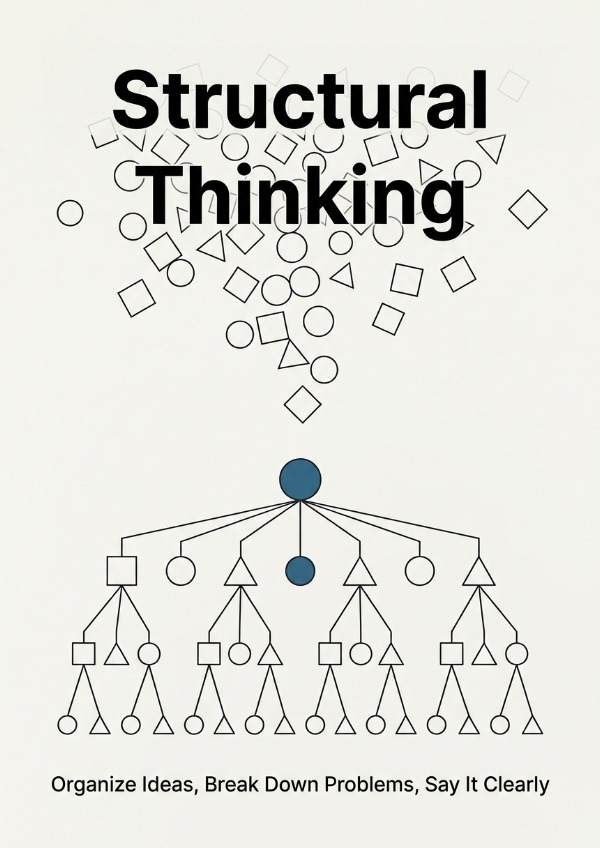
Some people can take a sprawling situation and lay it out so clearly that everyone in the room knows what the question is, what the options are, and what matters most. Others know just as much but cannot get the ideas into a shape anyone can follow. The difference is rarely intelligence or expertise. It is structure. This collection treats structural thinking as a thinking paradigm: the discipline of organizing ideas into clear hierarchies, with the main point on top, supporting points grouped by kind beneath it, no gaps, and no overlaps. Across seven modules and 36 sessions it moves from why the mind needs structure, through the building blocks of any hierarchy, the Pyramid Principle, structured problem solving, and structure in communication, to how organizations build structure into decisions, and finally to the limits of trees, categories, and frameworks. Cognitive science, consulting method, logic, and organizational practice are joined into one skill the reader can use tomorrow.

ParadigmField Guide
Earn4CreditsinCritical Thinking
7Modules36Sessions331Cards72Quizzes

Modules in this Collection’s System

What Structural Thinking Is

Structure is how a mind with limited working memory handles unlimited information.

5Sessions

The Building Blocks: Categories, Levels, and Logic

Every structure is built from a few basic moves: grouping, leveling, classifying, linking, and ordering.

5Sessions

The Pyramid Principle: Thinking Top-Down

Minto's Pyramid Principle turned structural thinking into a teachable method.

5Sessions

Structured Problem Solving

Structure is most valuable before writing happens: when a hard, vague problem needs to be turned into solvable pieces.

6Sessions

Structure in Communication

A structured idea still has to reach another mind.

5Sessions

Structure in Work and Decisions

Organizations that take structure seriously build it into hiring, planning, problem reporting, and knowledge management.

5Sessions

The Limits of Structure and a Practice for Life

Structure is a powerful tool, and like any tool it has an edge where it stops working.

5Sessions

What You'll Walk Away With

  • 1structural thinking protocol — define the question, cluster bottom-up, state the answer, build the pyramid top-down, test for MECE, altitude, and order, prune, and communicate answer-first.
  • 3grouping tests — MECE, consistent level of abstraction, and one of three named orders (time, structure, degree) — for auditing any breakdown.
  • 1issue-tree method for breaking hard problems into solvable pieces, with hypothesis-driven pruning.
  • 4communication structures — the Pyramid Principle, SCQA, storylines, and the 30-second spoken answer — for documents, slides, and meetings.
  • 1limits checklist — fuzzy categories, overlapping groups, framework traps, and feedback loops — for knowing when to stop structuring and start connecting.

You'll Have Answers To

  • ?Why does choosing the main point and the grouping count as the real thinking, not just formatting?
  • ?How does grouping ideas into chunks help a mind that can hold only about four things at once?
  • ?What makes a grouping MECE, and when should you stop trying to force it?
  • ?How do you break a hard, vague problem into pieces small enough to solve?
  • ?Where do hierarchies, categories, and frameworks stop working, and what takes over?

Critical Concepts Explored

Structural ThinkingChunkingMECELevels of AbstractionPyramid PrincipleSCQAIssue TreesHypothesis-Driven Problem SolvingModularitySemilattice
Editor's Note
“A single paradigm that connects how you think, solve, and communicate.”

The collection builds from cognitive science through consulting method to organizational practice, showing that the same moves — grouping, leveling, ordering, and answering first — serve a memo, an issue tree, and a hiring decision. The closing module is honest about limits: fuzzy categories, overlapping groups, and feedback loops that no tree can show. The capstone turns everything into a repeatable personal practice.

Editor's Brief
Who it's for
Young professionals, consultants, analysts, managers, founders, and ambitious students who write, present, analyze, and decide for a living and want a clear, repeatable method for organizing their thinking. No consulting background assumed.
What stands out
It treats structure as cognition, not formatting: pyramids and bullet points are the visible surface, but the collection teaches why the mind needs hierarchy, what the basic structural moves are, and where trees stop working. Three uses of one skill — thinking, problem solving, and communicating — are unified under one paradigm.
Read if
Read it if you want to turn any sprawling topic, vague problem, or tangled argument into something clear enough to decide and act on, and to know when to stop structuring and start looking for loops.
Gold Quotes
Structure is not added after thinking; choosing the main point, the groups, and the order is the thinking.

A person who cannot state their main point in one sentence usually has not finished thinking the idea through. The hierarchy is not formatting applied to a finished argument; building it is how the argument gets finished. Jeff Bezos made the same claim when he banned slide decks at Amazon: writing a structured narrative forces better thought about what matters and how the pieces relate.
About the Curator
TThinking Paradigms

Thinking Paradigms is a LearningFirst channel that teaches the ways of seeing that sit underneath good judgment: the mental frames, statistical habits, and philosophical distinctions that change what a person notices and decides. This collection applies that lens to structure, joining cognitive science, consulting method, logic, and organizational practice into one working model of how to organize ideas, break down problems, and communicate clearly.