Structural and Systematic Thinking
Last revised 10/8/2026

Structural and Systematic Thinking

Two complementary lenses for navigating complexity — structural thinking to see the skeleton, systematic thinking to see the dynamics

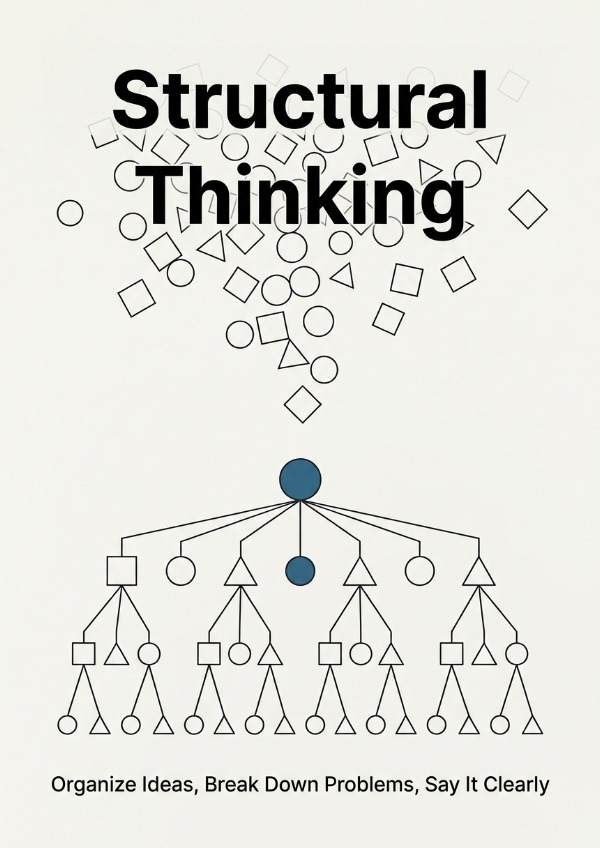
Most people think in sequences and react to surface features. This works for simple situations and breaks down the moment complexity enters. Structural thinking decomposes, categorises, and maps the static architecture of arguments, problems, and systems. Systematic thinking traces feedback loops, identifies leverage points, and anticipates what emerges from interaction. Together they form a complete cognitive toolkit: structure to see clearly, system to see deeply.

Cognitive ToolkitFramework
Earn4CreditsinCritical ThinkingScientific Thinking
6Modules30Sessions349Cards90Quizzes

Modules in this Collection’s System

The Cost of Unstructured Thinking

Why most people's default thinking fails under complexity — the cognitive habits that feel productive but produce shallow analysis, poor decisions, and miscommunication.

5Sessions

Structural Thinking: Seeing the Skeleton

The core toolkit: decomposition, hierarchy, abstraction layers, MECE logic, argument structure — how to see the architecture underneath complexity.

5Sessions

Structural Thinking in Practice

Applying structural thinking to real problems: structuring arguments, decisions, information, and thinking under pressure.

5Sessions

Systematic Thinking: Seeing the Dynamics

The core toolkit: systems, feedback loops, stocks and flows, delays, nonlinearity, emergence — how to see the behaviour that arises from interconnection.

5Sessions

Systematic Thinking in Practice

Applying systematic thinking: the iceberg model, leverage points, systems archetypes, unintended consequences, and the theory of constraints.

5Sessions

Two Lenses, One Problem

When to use structural vs systematic thinking, how to combine them for complex problems, and what neither lens can capture on its own.

5Sessions

What You'll Walk Away With

  • 5motivation sessions — why unstructured thinking fails under complexity, the surface-feature trap, the cost of miscommunication, linear thinking in a nonlinear world
  • 5structural foundations — decomposition, hierarchy and abstraction, the MECE principle, taxonomies, the architecture of an argument
  • 5structural practice sessions — structuring problems, arguments, decisions, information, and thinking under pressure
  • 5systematic foundations — what a system is, stocks and flows, feedback loops, delays, emergence
  • 5systematic practice sessions — the iceberg model, Meadows' leverage points, systems archetypes, unintended consequences, theory of constraints
  • 5integration sessions — the static and dynamic lens, structure-first method, limits of each lens, building a thinking toolkit

You'll Have Answers To

  • ?Why does most people's default thinking fail under complexity — and what specific cognitive habits produce shallow analysis?
  • ?What does structural thinking reveal that unstructured thinking misses — and how do decomposition, hierarchy, and MECE logic turn fog into a map?
  • ?What does systematic thinking reveal that structural thinking cannot — and how do feedback loops, delays, and emergence explain why interventions backfire?
  • ?When should you reach for the structural lens and when for the systematic lens — and what happens when you use the wrong one?
  • ?What makes someone genuinely good at thinking across domains — and why is the answer a repertoire rather than a single method?

Critical Concepts Explored

Structural vs Systematic ThinkingDecompositionMECE PrincipleHierarchy and AbstractionFeedback LoopsStocks and FlowsLeverage PointsSystems ArchetypesEmergenceThe Thinking Toolkit
Editor's Note
“The thinking course that teaches two complementary lenses for navigating complexity — and when to use each.”

Most thinking courses teach one method. This collection teaches two — structural thinking to see the skeleton underneath complexity, and systematic thinking to see the dynamics that make it move — then shows how to combine them for problems that require both lenses at once.

Editor's Brief
Who it's for
Students building a professional thinking toolkit — anyone who encounters complex problems with interdependent parts and wants to move beyond intuition to structured analysis.
What stands out
This collection teaches two complementary thinking modes (structural and systematic) as a unified toolkit rather than presenting one method in isolation.
Read if
Read if you have ever faced a complex problem and felt that your thinking was not structured enough to match the complexity — or if you want to understand why well-intentioned interventions so often produce the opposite of their intended effect.
Gold Quotes
Most people think in sequences and react to surface features. This works for simple situations and breaks down the moment complexity enters — when the problem has more than three moving parts, when causes are separated from effects by time and distance, when fixing one thing creates two new problems elsewhere.

The cost of unstructured thinking scales with the complexity of the situation. In a world saturated with information, interdependent systems, and compounding second-order effects, the ability to see underlying architecture is the difference between someone who navigates complexity and someone who drowns in it.
About the Curator
TThink Like Great Minds

Think Like Great Minds maps the cognitive frameworks that structured thinkers use — giving readers the tools to decompose complexity, trace dynamics, and build the judgement to know which lens to reach for.