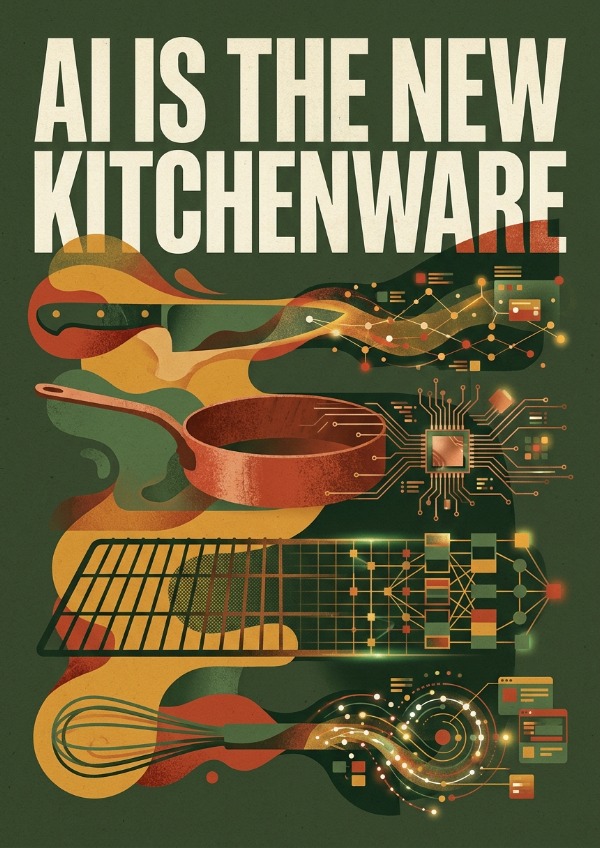
AI is the New Kitchenware
Last revised 9/30/2026

AI is the New Kitchenware

What the Dining Industry's Long History Predicts About Software and Content

Version: 0.2

Every other collection in this series compares the AI industry to an older industry's life cycle. This collection does something different. It uses kitchenware as a metaphor for what AI is to the software and content business, and it uses the dining industry's long history of coexisting with home cooking as a forecast for where that business goes. AI is kitchenware — production tools that let individuals make things previously requiring professional infrastructure. The hype says universal tools will kill the professional layer. Nobody makes that argument about food. Kitchenware has been universally available for centuries, and the dining industry has never been larger.

ReframeField Guide
Earn2CreditsinArtificial Intelligence
7Modules20Sessions163Cards50Quizzes

Modules in this Collection’s System

The Thesis: Everyone Has a Kitchen

AI is the kitchenware, not the food. Everyone has been able to cook at home for centuries, and nobody argues that it killed restaurants.

2Sessions

Why the Dining Business Didn't Die

Each tool that made home cooking easier also opened new commercial formats. Convenience, accountability, and the experience of eating out stayed worth paying for.

3Sessions

Cooking Is a Skill

Owning knives does not make you a chef. The tool enables the attempt, but taste and practiced judgment decide the outcome.

3Sessions

The Menu of the Software and Content Economy

Fine dining, casual dining, fast food, meal kits, packaged food, and food trucks each have a software and content equivalent, and cheaper tools change each segment differently.

3Sessions

The Professional Kitchen

A restaurant serves hundreds from one kitchen because it runs on systems a home cook does not have: consistency, division of labor, supply chain, equipment, and upkeep that never stops.

3Sessions

What the Business Actually Sells

The food is only part of what a restaurant sells. Curation, brand, accountability, and a designed experience carry much of the value, in dining and in software and content alike.

3Sessions

Where the Metaphor Points

Better tools lead to more professionals, a bigger market, a higher quality floor, and new formats. The businesses that disappear are the ones no better than home-made.

3Sessions

What You'll Walk Away With

  • 9structural parallels mapping the kitchenware–dining economy onto the AI–software/content economy — with fit ratings showing where the metaphor holds, bends, and breaks
  • 6market-segment translations connecting fine dining, casual dining, fast food, meal kits, food trucks, and ghost kitchens to their software and content equivalents
  • 5professional-kitchen principles explaining why scale, consistency, division of labor, supply chain, and capital investment exist in software the same way they exist in food
  • 1forecast framework using the dining industry's complete record to test any 'AI will replace professional X' claim

You'll Have Answers To

  • ?Why didn't universal kitchenware kill the dining industry, and what does that predict about AI and the software business?
  • ?What is the professional advantage that persists when everyone owns the production tools?
  • ?Which market segments in the software and content economy correspond to fine dining, fast food, meal kits, and food trucks?
  • ?What does a professional kitchen have that a home kitchen doesn't, and why does the same gap exist in software?
  • ?What new categories of software and content will emerge from universal AI tools, the way meal kits and ghost kitchens emerged from better kitchenware?

Critical Concepts Explored

Kitchenware metaphorQuality stratificationAccountability stackProfessional consistency moatCuration as productDivision of labor deepeningMarket segment translationRising quality floorSkill democratization ceilingExperience design layer
Editor's Note
“The sharpest rebuttal to 'software is dead' is sitting in every kitchen in America.”

Most AI commentary argues about whether professionals will survive. This collection skips the argument and looks at the data: kitchenware has been universal for centuries, and the dining industry has never been larger. The parallel is not decoration — it is the forecast.

Editor's Brief
Who it's for
Professionals, founders, content creators, software developers, managers, and investors who hear the 'software is dead' or 'content is dead' narrative and want a clearer lens on what is actually likely to happen.
What stands out
It uses the dining industry — the most complete dataset on what happens when production tools become universal — as a structural forecasting tool for the software and content economy.
Read if
Read if you want to take any 'AI will replace professional X' claim and test it against the dining industry's long record of coexisting with universal kitchenware.
Gold Quotes
AI is kitchenware. The dining industry has never been larger.

Every household has a full kitchen. Home cooking is a daily activity for billions of people. And yet US consumers now spend more eating out than eating at home. Universal production tools expanded the food economy rather than shrinking its professional layer — and the same expansion is coming to software and content.

About the Curator
AAI is the New _____

AI is the New _____ is a LearningFirst editorial series that examines AI through the lens of other transformations — industrial, financial, social, institutional — asking what history's recurring patterns say about AI's trajectory and what is genuinely new.