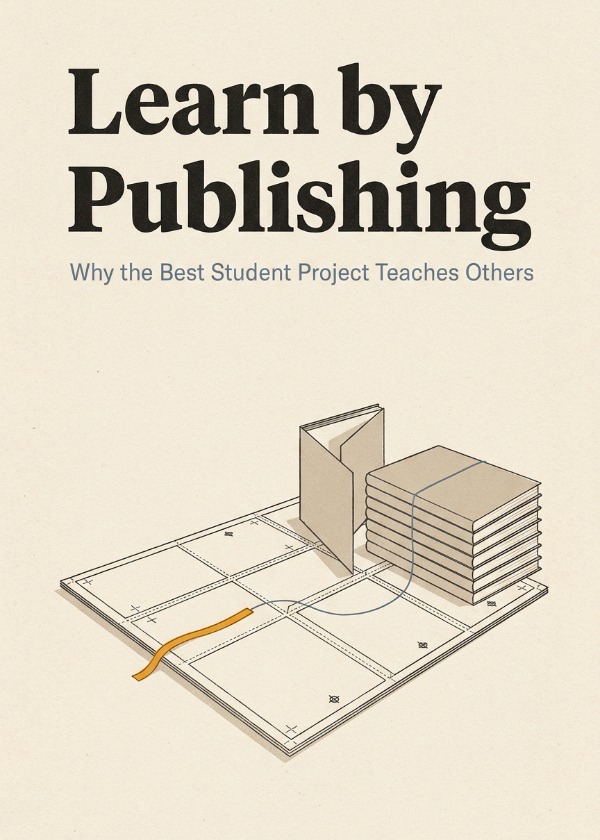
Learn by Publishing: Why the Best Student Project Teaches Others
Last revised 10/8/2026

Learn by Publishing: Why the Best Student Project Teaches Others

Research a topic in depth, build its structure, and publish it for real learners

This collection sets out one project design that any teacher, in any subject, can run: students choose a topic, research it as deeply as they can, organise what they find into a book of their own design, then build videos, slides or a website from it and publish the work so that other people learn from it. It draws together the research on learning by teaching, on project-based learning and on open pedagogy, and is candid about what that evidence does and does not show. It treats the finished book as the research base for the original project that follows, whether a scientific study, an invention, a business plan, a campaign or an environmental or economic solution. The later modules cover the team as a publishing house, distribution and impact, and the scoping, timeline, assessment and AI policy that make a tangible result certain for every team.
Project Design HandbookCoordinator's Companion
Earn5CreditsinEducationProject-Based LearningAcademic Research
7Modules41Sessions443Cards100Quizzes

Modules in this Collection’s System

The Case for the Educational Publishing Project

Why one publishing project combines so much learning value, and what the research on teaching, projects and open pedagogy supports.

5Sessions

Every Original Project Starts Here

Any information need can become a topic, and the finished book becomes the research base for the original project that follows.

9Sessions

Learning by Deep Research

Finding the audience, then researching to the deepest level students can reach before building anything.

6Sessions

Building the Structure

Turning research into an organised book: outline, sequence, explanation, practice, and the book as the base for other media.

6Sessions

The Team as a Publishing House

Roles, editorial standards, peer critique, accountability and cross-border partnerships.

4Sessions

Publishing, Distribution and Impact

Releasing the work, reaching learners, multiplying reach across formats, and measuring what readers learned.

5Sessions

Designing for a Guaranteed Output

Scoping, timeline, assessment, AI policy, curriculum fit, and growing the project into a school tradition.

6Sessions

What You'll Walk Away With

  • 8design strengths that one publishing project combines, from deep research and structure to teaching, teamwork, impact and a foundation for the next project
  • 7project pathways that turn the research book into the base for scientific, social, design, business, campaign, environmental and economic work
  • 7rungs of a depth ladder for showing each team how far down its research has gone, from facts to open questions
  • 6publishing-house roles that divide the work into interdependent jobs, from editor-in-chief to distribution lead
  • 6timeline milestones for a 12–16-week plan that protects the research phase from the deadline

You'll Have Answers To

  • ?What changes in how students research and organise a topic when someone else has to learn from what they produce?
  • ?How deep is deep enough before a team decides what to build and how to explain it?
  • ?How can the research every scientific study, invention, venture or campaign needs anyway become a published resource that teaches others?
  • ?How should a team divide research, writing, editing, design and distribution so that every student still learns the subject?
  • ?What scoping, milestones and assessment make a tangible, published result certain for every team?

Critical Concepts Explored

Learning by teachingIllusion of explanatory depthDepth before solutionsDesk and field researchDisposable and renewable assignmentsPublic productPositive interdependenceLateral readingMedia leverageGuaranteed minimum output
Editor's Note
“A practical, evidence-aware design for the student project that teaches others and always finishes.”

The collection moves from why the project works to choosing a topic, researching in depth, structuring a book, running the team and publishing to real readers. It is careful with the research, modest where effects are small, and concrete about scoping, milestones, assessment and AI use in an ordinary school year.

Editor's Brief
Who it's for
Secondary and upper-primary teachers in any subject, project and PBL coordinators, IB and AP Capstone coordinators and service-learning leads who want a project that reliably produces deep learning and a finished result.
What stands out
It joins the research on learning by teaching, project-based learning and open pedagogy to a step-by-step design, states plainly where that evidence is modest, and treats the finished book as the research base for the original project that follows.
Read if
Read it if you want one project your students can run in any subject that ends with a published piece of work other people actually learn from.
Gold Quotes
A poster shows what students did. A book written for a learner has to work, and that raises the standard of everything before it.

When someone at the other end has to learn from the product, every gap in research, structure and explanation becomes visible to the authors. The audience turns a summary of what students found into a test of whether they understood it.

About the Curator
GGlobal Competence Teachers

Global Competence Teachers is a LearningFirst editorial line for educators who treat their classroom craft as a serious professional discipline. The collections are written for teachers who want pedagogical depth — not pep talks, not buzzword tours, not certification exercises — and who care about the method as much as the message.