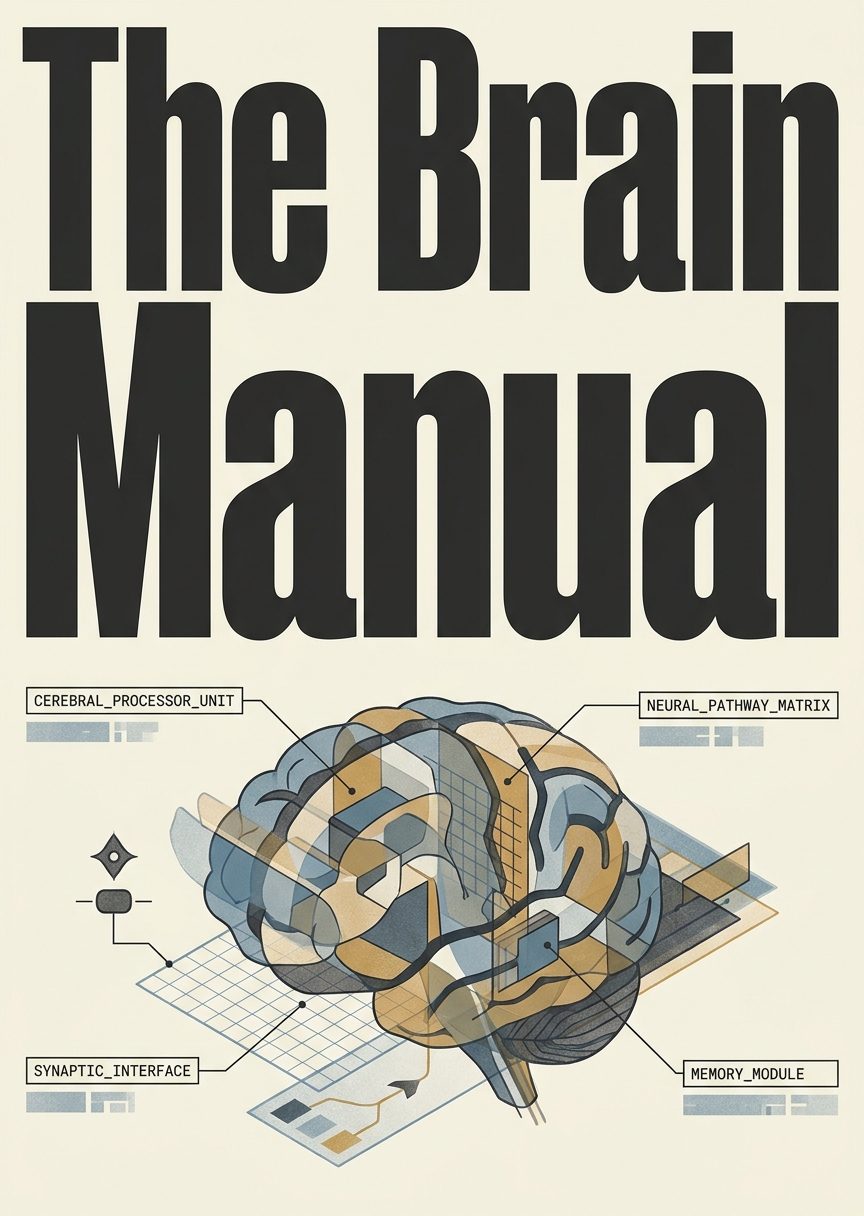
The Brain Manual
Last revised 10/4/2026

The Brain Manual

The architecture, operations, and maintenance of the most complex device you operate.

The brain runs every decision, every memory, every shift in attention, every habit, and every recovery cycle — and almost no one is taught how it works. This collection treats the brain as the most complex device a person will ever operate and provides the reference manual that never shipped with it. Each module maps a specific system — architecture, power, attention, memory, decision-making, cognitive load, emotional regulation, performance and recovery — and explains what the science has found about how that system operates, where its limits are, and what happens when it fails. Named research, specific mechanisms, measured quantities. The reader finishes with a structural understanding of their own cognition, grounded in evidence rather than heuristics.

PrimerReference Manual
Earn4.37CreditsinPsychology
8Modules32Sessions333Cards87Quizzes

Modules in this Collection’s System

The Brain's Blueprint

What the brain is made of and how its parts work together.

4Sessions

Power and Plasticity

How the brain fuels itself, why it tires, and how it rewires.

4Sessions

Attention — The Master Bottleneck

Why focus is limited, what determines where it goes, and what happens when it is divided.

4Sessions

Memory — From Sensation to Storage

How the brain encodes, holds, and retrieves information.

4Sessions

How the Brain Decides

Heuristics, biases, and the machinery behind every choice.

4Sessions

Cognitive Load — Managing the Processing Queue

Why information overwhelms, what the brain does about it, and how external design can help.

4Sessions

Emotion and Stress — The Override System

How emotions hijack, protect, and sometimes improve thinking.

4Sessions

Habits, Flow, and Recovery

How to automate routine, reach peak performance, and restore the system.

4Sessions

What You'll Walk Away With

  • 8subsystem maps for understanding how the brain's major operating systems connect and interact
  • 4capacity specifications for the brain's hardest bottlenecks — working memory, attention span, switch cost, and encoding depth
  • 5mechanism explanations for phenomena most people experience daily — fatigue, forgetting, decision deterioration, habit persistence, and flow
  • 3evidence frameworks for distinguishing replicated findings from contested claims — lateralisation, ego depletion, and neuroplasticity scope

You'll Have Answers To

  • ?Why does the brain consume 20% of the body's energy while accounting for only 2% of its weight — and what does that budget actually pay for?
  • ?What determines whether an experience becomes a lasting memory or is forgotten within the hour?
  • ?Why does decision quality deteriorate across a long day, and is 'willpower depletion' the right explanation?
  • ?How does the adult brain physically remodel in response to sustained practice — and what are the actual timescales?
  • ?What is the brain doing during sleep that no amount of wakefulness can substitute for?

Critical Concepts Explored

Action potential and synaptic transmissionDefault mode networkWorking memory bottleneckSelective attention and attenuationLevels-of-processing encodingForgetting curve and retrieval-induced forgettingSomatic marker hypothesisCognitive load theoryNeuroplasticity and long-term potentiationGlymphatic clearance system
Editor's Note
“The operating manual the brain never shipped with.”

Eight systems, thirty-two sessions, every mechanism attributed to named research. This collection replaces 'studies show' with Ebbinghaus's curve, Cowan's four-item limit, and Damasio's somatic markers — the actual specifications of the device running every thought.

Editor's Brief
Who it's for
Professionals, students, and self-directed learners who want a structural understanding of how their brain operates — not neuroscience as an academic subject, but the operating knowledge that makes cognition legible.
What stands out
Every mechanism is attributed to named research with specific dates and findings; where popular claims have been revised or contested (ego depletion, left-brain/right-brain, the 10% myth), the collection says so and presents the current state of the evidence.
Read if
Read this if decisions get worse across your day and you want to understand the machinery behind that — not tips, but the actual mechanisms of attention, memory, fatigue, and recovery.
Gold Quotes
The brain holds roughly four items in working memory — every thought, conversation, and decision runs through that bottleneck.

Cowan's 2001 revision of Miller's famous 'seven plus or minus two' estimate showed the true capacity is closer to four independent items. The apparent seven is achieved through chunking — compressing multiple pieces of information into single retrievable units. This is why expertise changes effective capacity so dramatically: a chess master sees board positions in chunks a novice must process piece by piece.

About the Curator
PPsychology Digest

Psychology Digest curates research-grounded collections on the science of mind, behaviour, and cognition — translating peer-reviewed findings into structured learning experiences for professionals and self-directed learners.