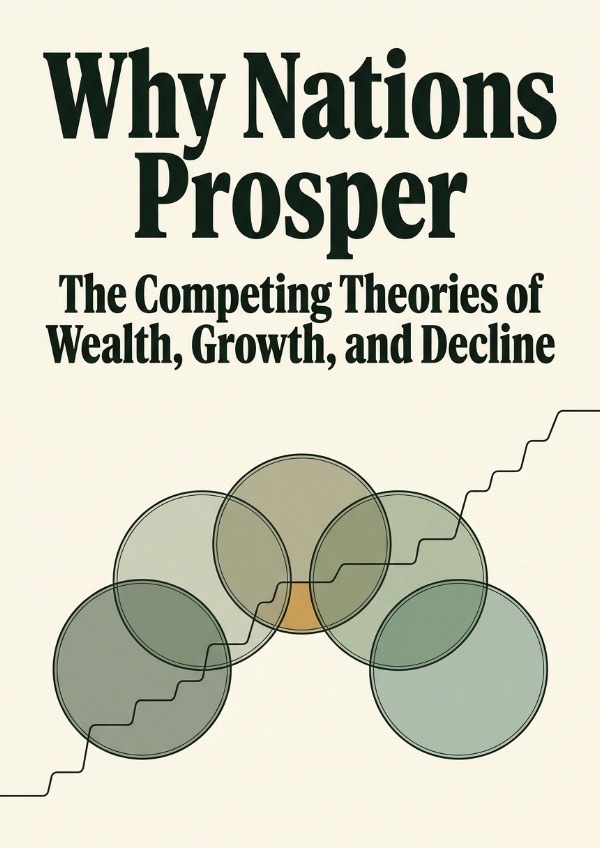
Why Nations Prosper: The Competing Theories of Wealth, Growth, and Decline
Last revised 10/3/2026

Why Nations Prosper: The Competing Theories of Wealth, Growth, and Decline

Growth, geography, culture, institutions, and strategy, tested against the same country cases

Two hundred years ago, living standards in the richest and poorest parts of the world differed by a factor of a few; today the gap is fifty times or more. Explaining that divergence is the oldest question in economics, and two consecutive Nobel prizes, in 2024 for work on institutions and in 2025 for work on innovation-driven growth, put it back at the center of attention. Across ten modules and 40 sessions, this collection lays out the major schools side by side: growth theory, geography and disease, culture and trust, institutions, the developmental state, human capital and demography, and the long-cycle theories of rise and decline. Each theory is presented at its strongest, with its best evidence and its most serious critics, and all of them are then tested against the same country cases, from the two Koreas to Argentina, Botswana, the United States, and China. The aim is a reader who can hold several explanations at once, name the theory behind any claim about national success or decline, and judge that claim by its evidence rather than its conclusion.
Field GuideDebate Map
Earn6CreditsinEconomicsPoliticsHistory
10Modules40Sessions439Cards80Quizzes

Modules in this Collection’s System

The Question: Why Are Some Nations Rich?

Levels, growth rates, and staying power: three questions, and how to judge any answer to them.

4Sessions

The Economist's Machinery: Growth Theory

Specialization, capital, ideas, and creative destruction as the engines of output.

4Sessions

Geography, Resources, and Disease

What location, climate, disease, and natural wealth can and cannot explain.

4Sessions

Culture, Values, and Ideas

Values, trust, and attitudes toward commerce as explanations, and the strongest objections to them.

4Sessions

Institutions: The Rules of the Game

How the rules that constrain power shape prosperity, and where the institutional account is weakest.

4Sessions

The State and Development Strategy

Deliberate strategy, from developmental states to growth diagnostics, and the debate over what policy can do.

4Sessions

People: Human Capital, Demography, and Distribution

Skills, age structure, and the division of gains as drivers of national outcomes.

4Sessions

Rise, Decline, and Renewal of Leading Powers

Why leading economies slow, what the long-cycle theories claim, and what separates renewal from drift.

4Sessions

Testing the Theories: Country Cases

The same theories, the same questions, applied to real countries.

4Sessions

Synthesis: Thinking in Multiple Theories

Holding several explanations at once, and turning them into a working diagnosis.

4Sessions

What You'll Walk Away With

  • 7schools of explanation — growth, geography, culture, institutions, state strategy, people, and long-cycle theory — each with its strongest evidence and its main critics.
  • 3distinct questions — levels, growth rates, and persistence — for checking what a theory of national wealth actually claims to explain.
  • 4evidence tests — natural experiments, cross-country regressions, case studies, and falsifiability — for judging any explanation of prosperity.
  • 4country case tests that apply every theory to the same nations under identical questions.
  • 1reader's toolkit of questions for any claim about a nation's rise or decline: which theory, what evidence, and what would prove it wrong.

You'll Have Answers To

  • ?Why did a world of broadly similar living standards in 1800 split into gaps of fifty times or more?
  • ?If North and South Korea share a language, a history, and a peninsula, what explains the gap between them?
  • ?Do institutions cause prosperity, or does prosperity build institutions?
  • ?Why do some resource-rich countries stall while Botswana and Norway turned their wealth into steady growth?
  • ?When a commentator says a great power is rising or declining, which theory are they using, and what would prove it wrong?

Critical Concepts Explored

Great DivergenceProximate vs. Fundamental CausesSolow ResidualNon-Rival IdeasCreative DestructionResource CurseInclusive and Extractive InstitutionsBinding ConstraintsDemographic DividendMiddle-Income Trap
Editor's Note
“A fair-minded map of the oldest argument in economics, tested case by case.”

Each school gets its strongest form, its best evidence, and its sharpest critics before any verdict is drawn. The country cases apply identical questions to every nation, from the Koreas to Botswana, and the closing modules turn the theories into a working method for judging new claims.

Editor's Brief
Who it's for
Professionals, investors, policy staff, students of economics and international affairs, and curious readers who meet arguments like Why Nations Fail or claims that a great power is rising or declining and want the full map behind them.
What stands out
It presents seven schools of explanation at their strongest, each with its best evidence and its most serious critics, then tests all of them against the same country cases under identical questions, with no presumption in favor of any theory or any country.
Read if
Read it if you want to name the theory behind any claim about national success or decline, see what it explains and what it leaves out, and judge it by its evidence.
Gold Quotes
No single theory explains the wealth of nations, but each one explains something the others miss.

Growth theory accounts for how output expands, geography for where early advantages fell, culture for how people cooperate and trade, institutions for who can safely invest, and strategy and demography for how countries climb. Each school also has cases it handles poorly. Holding several at once is how the strongest analysts read any single country.

About the Curator
EEcon Beyond

Econ Beyond is a LearningFirst channel that explains the economics behind everyday and emerging systems for general readers — the prices, incentives, and trade-offs hidden inside things people use without a second thought. This collection applies that lens to the oldest question in the field: why some nations grow rich and others do not.